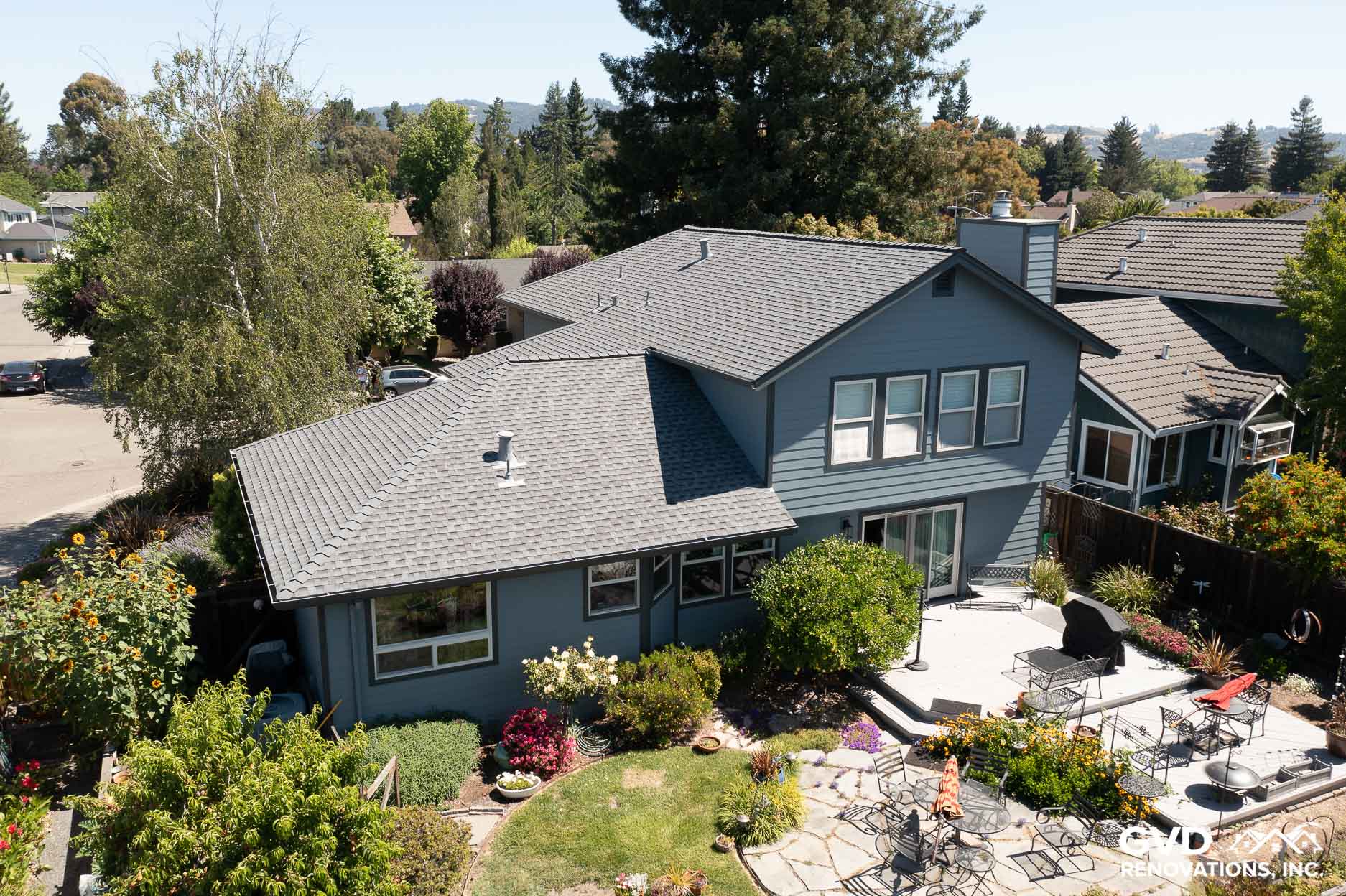
James Hardie Siding Contractor in Sebastopol
James Hardie fiber cement siding in Sebastopol, CA — installed to Hardie's published spec by a James Hardie Elite Contractor, with a detailed fixed-price proposal for the defined scope.
Sebastopol Siding & Window Replacement Experts
Give your home a classic, crisp-looking exterior with exterior siding from GVD Renovations & Remodeling. We have helped countless customers make their dream homes come alive. Let us help you determine the right materials, the best layout, and ideal installation schedule for your renovation.


Tap images to enlarge
See More Recent Projects →A Sebastopol James Hardie siding project, at a glance
GVD is a James Hardie Elite Contractor: we inspect the substrate, price one fixed total, and install to Hardie's published spec. Here is the shape of a typical Sebastopol re-side.
Siding Before & After Transformations Near Sebastopol
Genuine before-and-after results from recent GVD siding projects near Sebastopol.


Key Takeaways
- Manufacturer warranty coverage depends on the install matching James Hardie's published fastener, spacing, clearance, and flashing specifications.
- Siding is priced against wall square footage rather than floor area, so a sprawling single-story can cost more to re-side than a compact two-story.
- Overlay works on sound, flat, dry walls; a wall with rot, cupping, or an uneven substrate typically needs tear-off first.
- The baked-on ColorPlus factory finish holds color and sheen years longer than a field-applied coat, and carries its own warranty coverage.
- Vinyl costs the least of the common options upfront and does not provide the same fire resistance as fiber cement.
- Fiber cement recoups roughly 114% of its installed cost at resale on the 2025 Cost vs. Value benchmark, against about 97% for vinyl siding replacement.
Siding replacement in Sebastopol, CA: what the job actually involves
Siding replacement in Sebastopol means removing or covering the existing exterior cladding and installing a new weather-resistive barrier and siding assembly, sized, fastened, and flashed to the manufacturer's specification and installed by a licensed contractor working under City of Sebastopol or Sonoma County's building code. It covers everything from a single failed elevation to a full-home re-side with trim, soffit, and fascia replacement.
Siding is the outermost layer of a wall assembly that also includes the weather-resistive barrier and the flashing at every opening and penetration. The boards you see shed bulk water, but the barrier and flashing behind them are what direct any water that gets past the surface back out of the wall. How long the wall lasts is decided by those hidden layers, so a siding replacement is only as good as the assembly rebuilt underneath it.
GVD Renovations runs siding work with in-house project managers rather than a crew assigned the week of install, which matters on a job where the most consequential decisions get made after the first wall is opened.
GVD Renovations is a James Hardie Elite Contractor and an LP Master Level Preferred Contractor, which means the wall assemblies we build in Sebastopol are the ones those manufacturers warrant rather than a generic install. Call (916) 269-0761 to book a free in-home consultation.
Why fiber cement outperforms wood siding
The wood versus fiber cement question gets argued on appearance, but it is decided on how each material handles repeated wetting and drying at its most exposed points.
Fiber cement is significantly less susceptible to moisture-related swelling and decay than wood-based siding products, which is the property that decides the material question on most re-side projects. Wood siding absorbs ambient moisture, then swells, cups, and eventually deteriorates at the joints and butt ends where end grain is exposed.
James Hardie fiber cement holds up better through repeated wetting and drying cycles because its cement and cellulose composition does not swell the way solid wood or wood-composite panels do. That difference tends to show up first on north and west-facing walls, which stay damp longest and get the least direct sun to dry them out.
Homeowners in Sebastopol often see the pattern directly on an older house: siding still sound on the south and east elevations, but cupped, cracked, or paint-peeling on the shaded sides. Replacing only the damaged elevations while leaving sound material elsewhere is possible, but most homeowners choose a full re-side once one elevation shows failure, since the remaining walls face the same conditions.
What James Hardie fiber cement siding is made of
Understanding the material composition also clarifies its limits, which matters more than the marketing claims when specifying an assembly.
James Hardie fiber cement siding is made from Portland cement, sand, and cellulose fiber, pressed and cured into dense, dimensionally stable planks and panels. That composition is what gives the product its moisture and pest resistance, unlike wood siding, which is an organic material insects and fungi can feed on directly.
Termites do not feed on fiber cement, because the cellulose in the mix is bound into a cured cement matrix rather than left available as digestible wood fiber. That makes Hardie board a practical choice on older raised-foundation housing stock, where subterranean termite activity is a recognized concern across much of California.
Fiber cement is not waterproof in an absolute sense; it will absorb some surface moisture like any cementitious material. What matters practically is that it resists the swelling, cupping, and rot that turn absorbed moisture into structural damage in wood siding, and James Hardie's factory-applied finishes add a sealed surface layer that limits water intake further.
HardiePlank, board and batten, and ColorPlus options
Product line, texture, and finish are three separate decisions that often get sold as one. Sorting them out separately is what keeps a re-side from looking generic.
The right profile depends on what the home already is. GVD walks the options against the actual facade during the free consultation rather than quoting a stock package.
HardiePlank lap siding
HardiePlank in a 7.25-inch or 8.25-inch board width, giving roughly a 6 to 7 inch exposure once lapped, matches the horizontal siding pattern on most existing homes. Select Cedarmill texture reproduces a wood grain look, while Smooth suits trim details that call for a cleaner painted surface.
HardieShingle and board and batten for accent walls
HardieShingle reproduces a staggered or straight-edge shingle pattern for gable ends and dormers. Vertical board and batten fits a home when the architectural style calls for a farmhouse or modern accent, or when a property mixes a lap-sided main body with a vertical-accent entry or garage wall.
ColorPlus factory finish versus field painting
Field painting a primed board is a legitimate route and costs less upfront. ColorPlus buys a longer interval before the exterior needs attention again.
The tradeoff is upfront cost: ColorPlus panels cost more per square foot than primed boards painted on site, but the finish carries its own warranty coverage and typically holds color and sheen years longer than a field coat.
How much siding replacement costs in Sebastopol
Sheathing condition is invisible until the old siding comes off, so a quote written without a plan for possible rot or repair is a number that can move once the wall is open. We account for that contingency before you approve the work, so the full scope and one fixed price hold up when the crew reaches the sheathing.
Siding is priced against wall square footage rather than floor area, which is why a single-story home with a large footprint can cost more to re-side than a compact two-story with the same living space. Trim complexity, the number of windows and doors to flash around, and whether the existing siding comes off or gets covered move the number independently of material choice.
Vinyl siding replacement, $8 to $16 per square foot installed. The lowest upfront cost of the common options. Does not provide the same fire resistance as fiber cement.
LP SmartSide engineered wood, typically around 30% below fiber cement per square foot. Engineered wood substrate with a factory finish. Combustible on its own, but CAL FIRE-listed for California WUI zones when installed as part of a qualifying fire-rated wall assembly, which GVD builds where code calls for it.
James Hardie fiber cement, $11 to $20 per square foot installed. Carries a Class A fire rating on its own, the most common Class A siding choice GVD installs. Significantly less susceptible to moisture-related swelling and decay than wood-based siding products.
For the full pricing breakdown by scope, see our main siding page.
Rot repair is the line that most often changes a siding budget after work starts, because damaged sheathing is not visible until the old siding comes off. A tear-off quote that assumes zero sheathing replacement is a quote that has not accounted for the most common finding on an older home.
Fiber cement recoups roughly 114% of its installed cost at resale according to the 2025 Cost vs. Value Report, adding about $24,420 in resale value on the national benchmark project, compared with about 97% for vinyl siding replacement. Both figures are national benchmarks rather than Sebastopol-specific returns, so treat them as a relative ranking between materials rather than a prediction for a particular address.
James Hardie versus stucco, vinyl, and wood
The comparison below shows how the four common siding materials perform on the factors that matter most on a re-side: relative installed cost, fire rating, moisture performance, and resale return.
| Material | Relative installed cost | Fire rating | Moisture performance | Resale return (2025 Cost vs. Value) |
|---|---|---|---|---|
| James Hardie fiber cement | Highest of the four | Class A | Resists swelling and decay | Approx. 114% ($24,420 added value) |
| Stucco | Comparable to fiber cement | Class A as an assembly | Strong if crack-free; cracks admit moisture | Not separately reported |
| Vinyl | Lowest | Does not provide the same fire resistance as fiber cement | Moderate; seams can trap moisture | Approx. 97% |
| Wood | Varies by species | Combustible unless treated | Weakest on shaded elevations | Not separately reported |
The two materials most often cross-shopped here are fiber cement and stucco, and they diverge on exactly one thing: what happens to the wall once the surface cracks.
Fire rating and why it matters
Two quotes at the same price can carry different fire classifications. That difference does not show up in a walkthrough and does not show up in a photo.
James Hardie fiber cement carries a Class A fire rating on its own, and it is the most common Class A siding choice GVD installs. Class A is the highest of the standard fire-resistance classifications for exterior building materials.
LP SmartSide is combustible on its own but is CAL FIRE-listed for California WUI zones when installed as part of a qualifying fire-rated wall assembly, which GVD builds where code calls for it. Vinyl siding does not provide the same fire resistance as fiber cement, and it melts or deforms at temperatures fiber cement withstands without igniting.
Do you need a permit for siding replacement in Sebastopol?
Permit requirements for siding vary with how much of the exterior is affected and whether structural work is involved, so the answer for any specific home comes from City of Sebastopol or Sonoma County rather than from a general rule.
Permit review confirms the new assembly meets current building and fire code for the property's zone, and it is the step that puts an inspector's eyes on the weather-resistive barrier and flashing before the siding covers them.
Siding installed without a required permit creates a real problem at resale: unpermitted exterior work can surface during a buyer's inspection or an appraisal, which can delay closing or force retroactive permitting. Where a project stays within a straightforward panel swap and does not touch sheathing or structure, the review path through City of Sebastopol or Sonoma County is typically shorter than for a structural change.
Overlay versus tear-off on older siding
Whether the old siding stays or goes is the first real decision on a re-side, and it drives timeline, disposal, and the likelihood of finding repairs behind the wall.
James Hardie siding can go over sound existing siding when the wall underneath is flat, dry, and structurally solid, or it can go on after a full tear-off. Both are legitimate approaches, and the right one depends on what is under the old siding rather than on a blanket rule. Overlay skips the demolition step and shortens the project timeline, while tear-off exposes the sheathing for inspection and repair.
On an older Sebastopol home, the choice comes down to what GVD's crew finds during the free estimate: sound, flat wood siding with no rot can often take an overlay, while siding showing cupping, soft spots, or an uneven substrate typically calls for tear-off so the new panels sit flat and the sheathing underneath gets repaired first.
How long a siding project takes in Sebastopol
The on-site portion of a siding replacement generally takes one to two weeks, though a large footprint or extensive trim detail pushes past that. Every project follows the same four-phase sequence.
What the James Hardie warranty covers and how installation protects it
Warranty length is the most advertised and least examined number in a siding quote. The exclusions are where the actual commitment sits.
James Hardie backs its fiber cement products with a manufacturer warranty covering defects in the material itself, and ColorPlus finishes carry a separate finish warranty covering color fade and finish integrity. Warranty terms vary by product line, so the exact coverage period should be confirmed against the current James Hardie warranty documentation for the specific product installed. GVD adds a 10-year labor warranty on its own installation work.
Manufacturer warranty coverage depends on installation matching James Hardie's published specifications for fastener type, spacing, clearance, and flashing detail. Improper installation is what puts that coverage at risk, whether the siding goes on over an overlay or a fresh tear-off, which is why GVD's crews follow the manufacturer's fastening schedule for the applicable exposure zone rather than a generic spec.
Why Sebastopol homeowners choose GVD Renovations
GVD installs with our own in-house crews, so the same team that measures your fastening pattern and details your flashing is the team that executes it. A national franchise routes work to rotating out-of-area crews, where the fastening spacing and the flashing laps behind each window and trim board depend on whoever showed up that week, and improper installation is what puts a manufacturer's coverage at risk. When a permit is required, GVD handles the permitting process with the City of Sebastopol or Sonoma County, so the assembly is inspected rather than left to guesswork. You can also see the siding profiles and trim options in our showroom before you commit, which matters on homes near the Sonoma County median value of $1,102,033.
GVD Renovations holds California contractor license #989637, carries full liability and workers' compensation insurance, is a James Hardie Elite Contractor, and won the 2025 James Hardie Service Excellence Award. We are also an LP Master Level Preferred Contractor, an Anlin Certified and Authorized Dealer, and an Andersen Certified Contractor, which matters when a re-side also touches windows or trim.
We have taken siding work through plan review in Sebastopol and neighboring jurisdictions, so when a permit is required our submittals match what inspectors expect the first time.
Every Sebastopol project gets a dedicated project manager who coordinates scheduling, communication, and quality checks from the estimate through final walkthrough, which means one accountable point of contact rather than a different face at each visit, and who handles the permit filing directly with City of Sebastopol or Sonoma County when a permit applies.
Recently Completed Siding Jobs Near Sebastopol
Book a free in-home siding consultation in Sebastopol
A GVD project manager will look at your Sebastopol home, tell you which installation method the wall supports, and quote a fixed price against that finding. Call (916) 269-0761 to get on the schedule.
Serviced ZIP Codes: 95472
Try Our 3D Home Design Visualizer!
Ready to explore the possibilities for your home? Snap a photo to get started or spark your imagination with our sample homes.
Start Designing


Elite Certifications: James Hardie & LP® SmartSide
As a James Hardie Elite Contractor and LP® Certified Installer & LP® Master Level Preferred Contractor, we meet the highest standards for installation, service, and customer satisfaction in the industry.
We are fully insured with worker's compensation and general liability insurance to safeguard you and your home during our work.


GAF Certified Roofing Contractor


2025 James Hardie Service Excellence Award


LP Certified Installer Certificate


Angie's List Super Service Award

VSI Certified Installer

Best of Houzz 2020 Service Award


Financing made simple
- Fast application process
- Flexible payment options
- Check eligibility in minutes
Financing is offered through third-party lenders. Approval, rates, and terms depend on credit profile. Not all applicants qualify.

Checking eligibility will not impact your credit score






4.6/5

4.9/5

A+

5/5

5/5

5/5

5/5

4.8/5

5/5
Watch What Some of Our Clients Have to Say
Trusted by Thousands of Homeowners Across Northern California


James Hardie Siding Contractor Near Sebastopol
We bring the same crews, materials, and workmanship to every community around Sebastopol.
Frequently Asked Questions
about James Hardie Siding in Sebastopol
How much does siding replacement cost in Sebastopol?
In Sebastopol, James Hardie fiber cement runs about $11 to $20 per square foot installed and vinyl about $8 to $16. Siding is priced against wall square footage, and trim complexity, the number of openings to flash around, and hidden rot repair move the total independently of the material chosen.
James Hardie fiber cement or vinyl — which should I choose?
Fiber cement carries a Class A fire rating, resists moisture-related swelling and decay, and recouped about 114% of its cost at resale in the 2025 Cost vs. Value Report. Vinyl costs less upfront (about 97% resale return) but does not provide the same fire resistance. The right pick depends on budget, fire zone, and how long you plan to stay.
Do you need a permit for siding replacement in Sebastopol?
Permit requirements for siding vary with how much of the exterior is affected and whether structural work is involved, so the answer for any specific home comes from City of Sebastopol or Sonoma County rather than from a general rule.
Overlay or full tear-off — which is right for my siding?
Whether the old siding stays or goes is the first real decision on a re-side, and it drives timeline, disposal, and the likelihood of finding repairs behind the wall.
Does new siding raise my home's value?
Per the 2025 Cost vs. Value Report, fiber cement siding recoups roughly 114% of its installed cost at resale — about $24,420 in added value on the national benchmark project — versus about 97% for vinyl. Both are national benchmarks, so treat them as a relative ranking rather than a prediction for a specific address.
How long does a siding project take in Sebastopol?
Most re-side projects run from a few days to a couple of weeks depending on home size, trim complexity, and whether the crew tears off or overlays. Hidden sheathing rot found at tear-off is what most often extends the schedule.