Bathroom Remodeling in Granite Bay
Granite Bay bathroom remodeling scoped at your house, not over the phone, for homes in Granite Bay, Loomis, and Roseville, with permits handled when required and a fixed price in a detailed digital proposal.
Granite Bay Bathroom Transformations
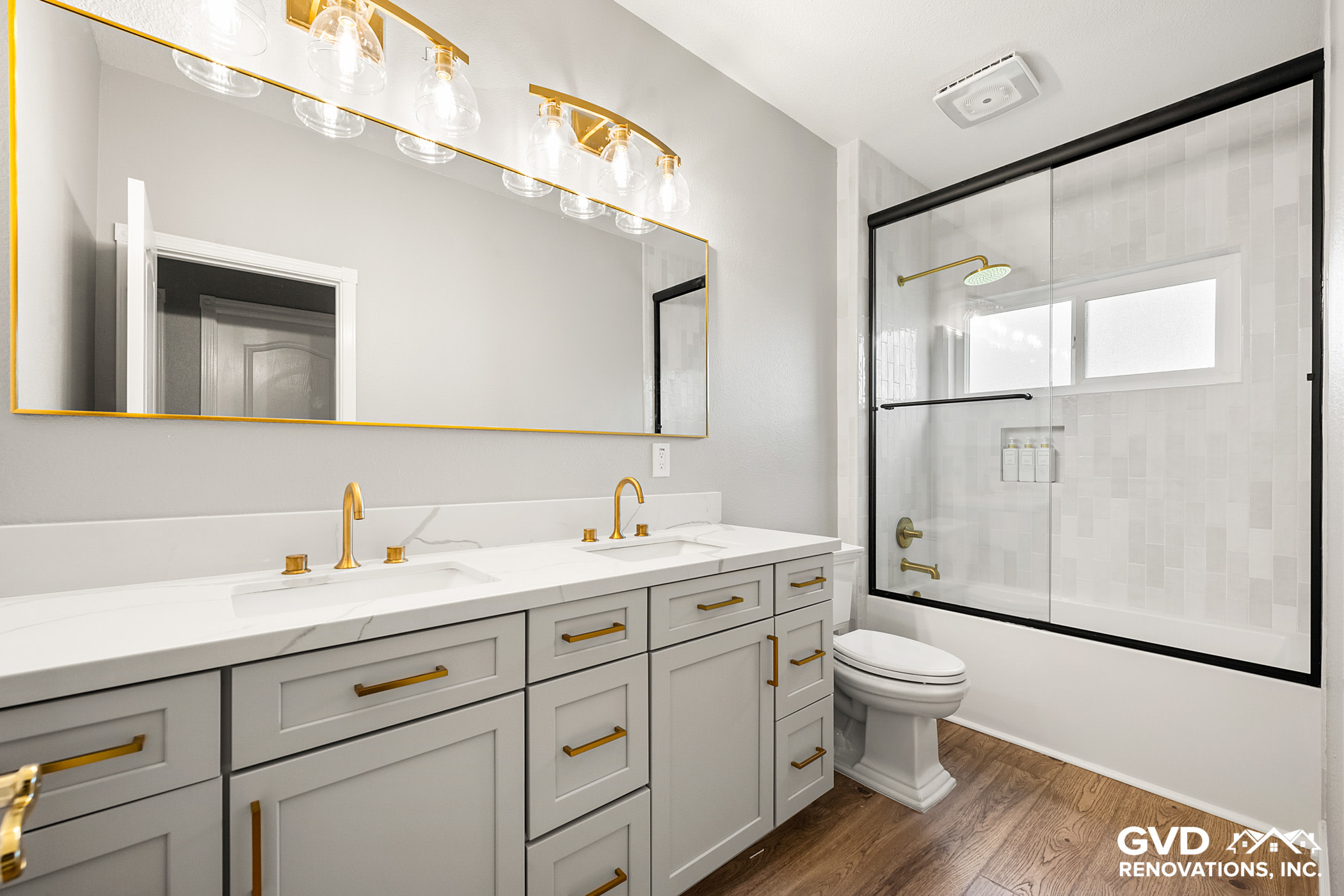
See real GVD bathroom remodels across Granite Bay and nearby Northern California communities — tub-to-shower conversions, walk-in showers, and full gut renovations, each priced in a detailed fixed-price quote.


Tap images to enlarge
See More Recent Projects →A Granite Bay bathroom remodel, at a glance
What most Granite Bay homeowners can expect from a GVD bathroom remodel, before the details of their own room are measured.
Bathroom Before & After Transformations Near Granite Bay
These are actual GVD bathroom remodels from the Granite Bay area — see the transformations for yourself.


Key Takeaways
- Replacing fixtures in their existing locations generally does not need a permit, while moving a drain line, adding a circuit, or relocating a wall typically does.
- A bathroom remodel commonly falls between $18,000 and $100,000 or more depending on scope, with most projects landing in the middle tier.
- Sequence controls cost: tiling before a rough-in inspection risks tearing out finished work, and painting before tile means repainting afterward.
- Old cast-iron or galvanized drain lines and a failing subfloor are the two findings that most often move a bathroom budget after demolition starts.
How GVD approaches a bathroom remodel
GVD Renovations remodels bathrooms in Granite Bay at every scale, from new fixtures and tile in the existing footprint to full guts that move plumbing and reconfigure the room. Design, any required permits through Placer County, construction, and cleanup run as one job under one project manager. We also remodel bathrooms in nearby Loomis, Roseville, and Sun City Roseville.
We are a licensed local contractor rather than a franchise routing your bathroom to rotating out-of-area crews, and the crew that shows up is the one we manage.
GVD Renovations is family-owned and fully insured, with liability and workers' compensation coverage, under California license #989637.
How much a bathroom remodel costs in Granite Bay
Whether the supply lines and drains stay where they are or have to move is the single largest lever on a bathroom number, because relocating them means opening walls and floor and reworking the rough-in. Confirming what has to move before you call keeps the estimate honest.
Focused update, $18,000 to $30,000. New vanity, tile, and fixtures inside the existing footprint. The plumbing stays where it is and the layout does not change, which is what holds the price in this range.
Mid-range remodel, $30,000 to $55,000. Adds a walk-in shower or a tub-to-shower conversion, better lighting and ventilation, and new finishes on every visible surface. This is where most projects land.
Primary bath with a layout change, $55,000 to $100,000 and up. Supply lines and drains relocate, the room is re-planned, and the shower and cabinetry are custom. Typical for primary suites and accessibility conversions.
The full cost breakdown lives on our main bathroom remodeling page.
Add 15 to 20 percent to whichever tier fits. If nothing turns up you keep it, and on an older home something usually turns up.
Homes across this market were built to different plumbing standards over different decades, so a bathroom gets scoped per property rather than per area. The usual findings are corroded cast-iron or galvanized drains and a subfloor softened by years of slow leaks. Neither shows up until the floor is open, which is why the budget should cover what the room needs structurally before it is divided among fixtures and tile.
Settle which of the three your bathroom actually needs before comparing quotes. Two contractors pricing different tiers will produce numbers that look far apart for reasons that have nothing to do with either one being expensive.
Quartz versus tile for a shower surround
Tile is by a wide margin the more customizable option, and that flexibility is most of what the price difference buys in the other direction.
| Surround | Relative installed cost | Maintenance | Best suited to |
|---|---|---|---|
| Quartz or solid-surface slab | Highest of the three | Wipe down; no grout to reseal | Owners prioritizing low upkeep over pattern choice |
| Ceramic or porcelain tile | Lowest | Periodic grout resealing | The widest range of pattern, color, and format options |
| Natural stone tile | Between the two | Sealing on a regular cycle | A specific stone look, accepting the upkeep that comes with it |
Choose slab if you want the least upkeep and can accept fewer pattern options; choose tile if you want the most design freedom and are comfortable resealing grout from time to time. Natural stone sits between them on price and asks for regular sealing.
Tub-to-shower conversion or a full bathroom remodel?
Homeowners often arrive certain they want a conversion and leave having decided on a full remodel, or the reverse. Both outcomes are fine; deciding without asking is not.
If the tub is the only thing wrong (it is hard to step over, rarely used, or the surround grout keeps growing mold), a conversion replaces it with a walk-in shower and leaves the rest of the room untouched, at a fraction of full-remodel cost. When the vanity is undersized, the layout does not work, or the floor is going too, doing the whole room at once is usually the cheaper path over time.
Our shower replacement page for Granite Bay covers conversions and walk-in builds in depth, including what each route costs on its own.
Do you need a permit to remodel a bathroom in Granite Bay?
Homeowners should expect any bathroom project that reroutes plumbing to be reviewed by Placer County, and should treat a proposal to skip that step as a warning rather than a saving.
The trigger is usually the work behind the wall. Surface and fixture swaps typically do not need a permit; relocated plumbing, new circuits, framing changes, and curbless shower conversions typically do, and those are inspected at rough-in and at final.
If the work calls for a permit, GVD files it with Placer County and coordinates each inspection, so you are not tracking it yourself.
The order a bathroom remodel should be done
A bathroom is built from the walls outward and from the rough-in forward, and the sequence reflects that rather than any scheduling convenience.
Getting the order wrong is expensive: finished tile over an uninspected rough-in may have to come out, and paint applied before tile work usually gets redone.
How long a bathroom remodel takes
Most homeowners are looking at 2 to 8 weeks with the bathroom out of service, which is worth planning around in a single-bathroom household.
The front end depends on permit review, if the scope needs one. After that, the common delays are backordered tile or slab and concealed damage found once the walls open.
How to vet a bathroom remodeling contractor
The questions below take one phone call each and are the difference between a warranty that pays and one that does not.
Check the Contractors State License Board record first, then get in-home quotes from two or three companies. A walkthrough produces a far more accurate number than a phone estimate, because what moves a bathroom budget is not visible over the phone.
Verify the license and insurance
Search the contractor's license at cslb.ca.gov, confirm it is active and free of disciplinary actions, and request certificates for liability insurance and workers' compensation. Without workers' comp, an on-site injury can become the homeowner's problem.
Red flags to watch for
- Pressure to sign the same day as the estimate.
- No license number or insurance certificate on request.
- Silence about permits on a job that obviously needs one.
- A single number with no written description of the work.
- A big upfront payment before any permit or material order exists.
Why Granite Bay homeowners choose GVD Renovations
GVD writes a fixed-price proposal that states the full scope and one total, so the number you approve is the number you pay even after demolition exposes work nobody could see at the estimate. That detailed total is what protects you when the subfloor or framing turns out worse than expected, because the contingency is inside the price rather than added on later. Our in-house team self-performs most of the demolition, the rough-in, the waterproofing, and the tile, so the person who set the pan is accountable when it is tested. A national franchise runs rotating out-of-area crews and defers to a distant office.
One project manager stays with your bathroom from the first visit to the final walkthrough, and the company carries an A+ Better Business Bureau rating.
Our permit submittals are built around what Placer County reviewers and inspectors look for, which helps keep rough-in and final inspections on schedule.
You can see tile, quartz slabs, and cabinetry in person at our design showroom at 6848 Five Star Blvd #6 in Rocklin, about 8 miles from Granite Bay (roughly a 15-minute drive), and lock in selections with a designer before construction starts.
GVD Bathroom Remodels in the Granite Bay Area
Serviced ZIP Codes: 95746

4.6/5

4.9/5

A+

5/5

5/5

5/5

5/5

4.8/5

5/5
We are fully insured with worker's compensation and general liability insurance to safeguard you and your home during our work.


GAF Certified Roofing Contractor


2025 James Hardie Service Excellence Award


LP Certified Installer Certificate


Angie's List Super Service Award

VSI Certified Installer

Best of Houzz 2020 Service Award


Financing made simple
- Fast application process
- Flexible payment options
- Check eligibility in minutes
Financing is offered through third-party lenders. Approval, rates, and terms depend on credit profile. Not all applicants qualify.

Checking eligibility will not impact your credit score
Watch What Some of Our Clients Have to Say
Trusted by Thousands of Homeowners Across Northern California


Bathroom Remodeling Near Granite Bay
We bring the same crews, materials, and workmanship to every community around Granite Bay.
Frequently Asked Questions
about Bathroom Remodels in Granite Bay
What should I budget for a bathroom remodel in Granite Bay?
Plan on $18,000 to $30,000 for a same-footprint update, $30,000 to $55,000 for a mid-range remodel with a new shower, and $55,000 to $100,000 or more when plumbing and the layout move. Hold a 15 to 20 percent reserve for concealed conditions in older homes.
How long does a bathroom remodel take?
Typically 2 to 8 weeks of work, depending on scope. Jobs that need rough-in inspections, custom materials, or repairs behind the walls sit at the longer end.
Do I need a permit to remodel a bathroom in Granite Bay?
It depends on the work. Replacing fixtures in place usually does not; moving drains, adding circuits, or changing walls usually does. When a permit is required, GVD handles it through Placer County.
Should I convert my tub to a shower or remodel the whole bathroom?
A conversion makes sense when only the tub is the issue. When the vanity, flooring, or layout also need work, doing the room at once is usually cheaper over time. GVD quotes both routes.
Why budget extra beyond the bathroom quote?
Budget 15 to 20 percent beyond the quoted scope for concealed conditions such as old cast-iron or galvanized drains and a damaged subfloor. On pre-1980 homes that reserve often gets used.
Can I see materials before my bathroom remodel starts?
At our Rocklin showroom on Five Star Blvd. You can compare tile, slabs, vanities, and fixtures in person and lock in selections before construction starts.