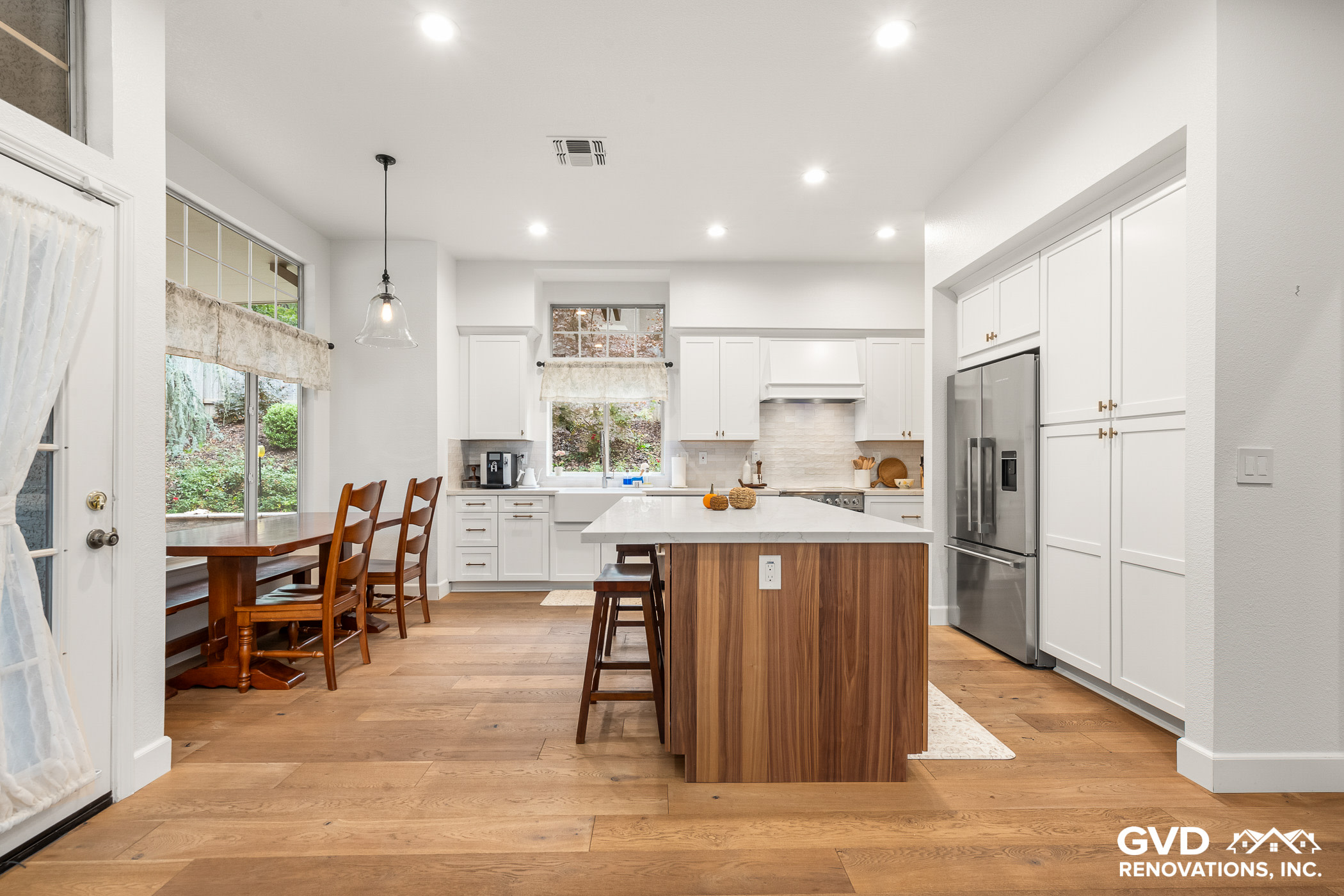
Kitchen Cabinets in Marysville
Fixed-price kitchen cabinet installation in Marysville, CA — measured, installed, and finished by one accountable local crew.


A Marysville kitchen cabinet project, at a glance
GVD measures, installs, and finishes your cabinets under one accountable team. Here is the shape of a typical Marysville cabinet install.
Real Marysville-Area Cabinet Projects: Before & After
A look at GVD kitchen and cabinet work from the Marysville region.


Key Takeaways
- A full kitchen cabinet install, cabinets and labor together, runs $8,000 to $30,000 depending on cabinet tier and kitchen size.
- Installers price cabinet labor by linear foot rather than by the room, so a 10-foot galley run costs less to install than a 25-foot L-shape with an island.
- Refacing or repainting existing boxes costs less than replacement and works well when the boxes are structurally sound and the layout is not changing.
- Walls out of plumb, corners out of square, and sloping floors all add scribing and shimming time that a flat quote will not show until the crew is on site.
- IKEA and Home Depot both sell cabinets and offer installation referrals. Neither sends its own crew, which matters when something behind the wall needs fixing mid-job.
Kitchen cabinet installation in Marysville, CA
Kitchen cabinet installation in Marysville covers everything from a straight swap of stock boxes to a full custom layout with a waterfall island. The installer you hire determines whether that swap goes smoothly or turns into a change-order fight.
Pulling old cabinets off the wall exposes the studs, plumbing, and wiring behind them on the first day of demolition, before anyone has committed to a final count. That is exactly why a firm total price in a detailed digital proposal protects you better than an estimate that can move once the boxes come down. With GVD, the number you approve is the number you pay, and there are no surprise charges once the crew is on site.
We measure, we order, and we install. When the wall behind your old uppers turns out to be out of plumb, the person solving it works for the same company that quoted you.
A fixed-price quote is only meaningful if it covers the unknowns. Ours states what happens if demo turns up rot or old wiring, so that conversation happens before you sign rather than after.
Schedule a free in-home consultation: call (916) 269-0761.
What it costs to install kitchen cabinets in Marysville
What sits behind the old boxes decides whether a job runs clean or turns into a different number, since rot in the wall, wiring that no longer meets code, and studs that are out of plumb are the classic mid-project change orders. Knowing those brackets before you call keeps the conversation grounded in the scope your kitchen actually carries rather than a hopeful guess.
Full cabinet installation, cabinets and labor, $8,000 to $30,000. The installed total for a standard kitchen. Where you land depends on kitchen size measured in linear feet, cabinet tier, and how much of the existing kitchen has to come out first. Cabinets typically carry 30 to 40% of a full kitchen budget, driven by both product cost and the labor to set them.
Fully custom cabinetry, $150 to $500 per linear foot. Built to the exact dimensions of the room rather than from standard sizes, often with premium European hardware and typically a 6 to 10 week manufacturing lead time. The tier to choose when the layout is unusual or the storage requirement is specific.
Installers price by linear footage rather than by the room. A small galley kitchen with 10 linear feet of cabinetry costs less to install than an L-shaped kitchen with an island, even when both use the same cabinet line. For the full pricing breakdown by scope, see our main kitchen cabinets page.
Cabinets alone, installed, typically account for 30 to 40% of a full kitchen budget, driven by both product cost and installation labor.
What changes the price of your cabinet install
Two variables move a cabinet quote more than any others: how much cabinetry you are installing, measured in linear feet, and how much demolition happens before the new boxes go in. A quote that looks low often excludes one of these and adds it back as a change order once the crew arrives.
Interior fittings are where cabinet budgets drift. Each is a reasonable small decision on its own, and the cumulative effect on a full kitchen is a double-digit percentage.
Kitchen size and cabinet count
Hanging a cabinet takes the same time in a big kitchen as a small one. What changes the number is how many cabinets there are and how many walls they are spread across.
Removing and disposing of old cabinets
We remove and dispose of the old cabinets as part of the job. Doing it yourself before the crew arrives usually costs more than it saves once the wall repair is counted.
Wall condition, fillers, and out-of-square corners
Fillers and scribing are not defects, they are how a square cabinet run meets a house that has moved. Quoting them accurately requires looking at the walls first.
IKEA, semi-custom, and custom cabinets compared
Choosing between IKEA, semi-custom, and fully custom comes down to money and fit: how much you are willing to spend for exact-fit sizing and hardware quality, against a lower price point with more assembly and adjustment work on your end.
| Cabinet tier | Lead time | Fit and adjustability | Hardware quality |
|---|---|---|---|
| IKEA (SEKTION) | In stock to a few weeks | Limited sizing, fillers needed | Standard soft-close, entry-level |
| Semi-custom | 4 to 8 weeks | Modified stock sizes, more options | Blum, Hettich-grade hardware common |
| Fully custom | 6 to 10 weeks | Built to exact kitchen dimensions | Premium European hardware |
Assembly time is the hidden variable in the tier decision. A pre-assembled semi-custom box arrives ready to hang; a flat-pack box is an hour of labor before it reaches the wall.
Semi-custom cabinets are built in standard depths and heights but offered in a wider range of widths, finishes, and interior configurations than stock lines. They typically deliver solid plywood box construction and soft-close hardware well below the price of fully custom work. For most kitchens with a standard layout, semi-custom balances fit and cost without paying for bespoke joinery the room does not need.
Certified is not the same as employed. A referral network installer may be excellent, and they may also carry less insurance than the job warrants. Both are worth checking before you book.
Handyman vs licensed cabinet installer: what you risk
For a pure box swap with nothing moving behind the wall, an unlicensed installer is a defensible choice. For anything touching plumbing, gas, or electrical, it is not, and California's rules are explicit about that.
The red flags to watch for include no proof of a contractor's license for jobs over California's $1,000 threshold, no liability insurance certificate offered without you asking, cash-only payment requests, and no detailed scope of work. Any one of these should stop you before you sign.
Appliance and plumbing tie-in work, moving a sink base cabinet, rerouting a dishwasher line, or adjusting a gas range hookup, argues for a licensed contractor. In California, moving plumbing or electrical is licensed trade work, so it should be handled by a contractor whose classification covers it, not left to whoever installs the boxes around it. An unlicensed installer who touches a gas line creates a liability that lands on the homeowner if an inspector or insurer ever asks who did the work.
Do you need a permit to install kitchen cabinets in Marysville?
If the project stays within the existing footprint and does not touch utilities, it usually proceeds without a permit under California's general remodeling rules.
Permitting becomes necessary once the project moves plumbing or gas lines, changes electrical circuits, or alters a load-bearing wall. GVD handles the permitting process with City of Marysville or Yuba County whenever a project's scope crosses that line, so you are not the one tracking down inspections.
Permit history can come up when a home goes on the market, particularly for jobs that involved plumbing or electrical changes, since unpermitted work in those categories can slow escrow or surface during disclosure.
How long a Marysville cabinet installation takes
Install is the short part: demo, wall prep, hanging, and hardware adjustment inside 2 to 4 days for a standard kitchen. The wait is upstream of it.
How to prepare your kitchen before the installers arrive
The list below is short and it genuinely helps. Every item on it is something the crew would otherwise be doing instead of installing cabinets.
What to ask a Marysville cabinet installer before you hire
The list below takes ten minutes on a phone call and rules out most of the outcomes homeowners complain about afterwards.
- Ask for the California contractor license number and confirm it directly through the CSLB website rather than taking their word for it.
- Ask whether the quote is fixed-price or subject to change orders once demo starts, since a vague labor-and-materials estimate is where surprise costs hide.
- Ask who is doing the physical installation, an in-house crew or an outside referral, because that answer determines who is accountable if something goes wrong mid-job.
- Ask for proof of general liability insurance and workers' compensation coverage.
- Ask what happens if the crew finds rot, mold, or outdated wiring behind your existing cabinets once demo starts.
How our fixed-price Marysville installs work
Everything downstream depends on the measure being right, because a cabinet order built to a wrong number is a remake rather than an adjustment. That is why the consultation is a measure rather than a sales visit.
A single project manager stays with your job from that quote through the final walkthrough, coordinating the schedule, answering questions, and checking the work at each stage rather than handing you off between separate scheduling and installation teams.
Why Marysville homeowners choose GVD Renovations
One project manager at GVD carries your kitchen across measure, order, and install, which matters most during the lead time in the middle when cabinets are on order and a job with no single owner tends to stall. You call the same person who templated the run, so a delayed delivery or a field question gets answered rather than passed down a chain. The people setting your cabinets are our own in-house crews working as one accountable team from quote to walkthrough, not rotating out-of-area crews staged in for a week. You can also see door styles, finishes, and hardware in person before you commit, so the samples you choose are the surfaces that show up in your kitchen. When a permit is required in Marysville, GVD handles the permitting process with the City of Marysville or Yuba County.
GVD Renovations holds California contractor license #989637 and an A+ rating from the Better Business Bureau. GVD is the 2025 James Hardie Service Excellence Award winner, the only California contractor to receive that award that year, and holds James Hardie Elite status. We are a family-owned company that uses our own trained crews on every job, backed by full liability and workers' compensation insurance.
We work across Yuba County and neighboring jurisdictions, and where a cabinet project's scope reaches plumbing, gas, electrical, or structure, we handle that permitting process rather than leaving it to you.
Our Rocklin showroom is an easy drive from here. See cabinet materials, door styles, and hardware finishes in person before you commit to a layout.
Recent Cabinet Projects Near Marysville
Get a fixed-price cabinet quote in Marysville
Call (916) 269-0761 to schedule a free in-home consultation. We measure your Marysville kitchen, walk you through cabinet tiers and hardware options, confirm whether the scope brings a permit into play, and follow up with the full scope and a firm total price in a detailed digital proposal.
Serviced ZIP Codes: 95901, 95961

4.6/5

4.9/5

A+

5/5

5/5

5/5

5/5

4.8/5

5/5
We are fully insured with worker's compensation and general liability insurance to safeguard you and your home during our work.


GAF Certified Roofing Contractor


2025 James Hardie Service Excellence Award


LP Certified Installer Certificate


Angie's List Super Service Award

VSI Certified Installer

Best of Houzz 2020 Service Award


Financing made simple
- Fast application process
- Flexible payment options
- Check eligibility in minutes
Financing is offered through third-party lenders. Approval, rates, and terms depend on credit profile. Not all applicants qualify.

Checking eligibility will not impact your credit score
Watch What Some of Our Clients Have to Say
Trusted by Thousands of Homeowners Across Northern California


Kitchen Cabinets Near Marysville
We bring the same crews, materials, and workmanship to every community around Marysville.
Frequently Asked Questions
about Kitchen Cabinets in Marysville
How much does kitchen cabinet installation cost in Marysville?
A full cabinet installation in Marysville — cabinets and labor — typically runs $8,000 to $30,000 depending on kitchen size, cabinet tier, and how much of the old kitchen comes out first. Fully custom cabinetry runs about $150 to $500 per linear foot.
IKEA, semi-custom, or fully custom — which should I choose?
IKEA is quickest and lowest cost but limited on sizing; semi-custom (about 4 to 8 weeks) modifies stock sizes with better hardware; fully custom (6 to 10 weeks) is built to exact dimensions for unusual layouts or specific storage needs.
Do I need a permit to install kitchen cabinets in Marysville?
Cabinets alone, in the same footprint, generally do not require a permit. One is needed once the project moves plumbing or gas lines, changes electrical circuits, or alters a load-bearing wall — and GVD handles that filing when it applies.
How long does a cabinet installation take?
The install crew is usually in and out in 2 to 4 days. The longer part of a 6 to 10 week project is manufacturing lead time and your own decisions on finishes and hardware.
How do you update old cabinets without replacing them?
Refacing, meaning new doors, drawer fronts, and hinges over the existing cabinet boxes, or repainting the existing boxes, both cost less than a full replacement. Either works well when the boxes underneath are still structurally sound and the layout does not need to change.
How do you remove kitchen cabinets without damaging the wall or countertop?
Removal starts by unscrewing the cabinet from the nailer strip that anchors it to the wall studs, not by prying at the face frame. Countertops get unscrewed from the cabinet base and lifted clear before any cabinet comes down, which avoids cracking stone or laminate that is being reused.