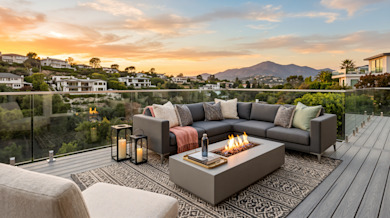
Deck Builder in Corte Madera
Decks in Corte Madera and nearby Larkspur and Mill Valley, with airflow and board choices suited to marine damp. Composite, redwood, or PVC, framed to code at one fixed price in a detailed proposal.
Expert Deck Builders in Corte Madera
Transform your home's exterior with timeless elegance using GVD Renovations & Remodeling' top-quality decking solutions. Our expert team has assisted numerous homeowners in bringing their dream outdoor spaces to life. Allow us to guide you in selecting the perfect materials, designing an optimal layout, and scheduling a seamless installation for your decking renovation.


Tap images to enlarge
See More Recent Projects →A Corte Madera deck project, at a glance
What most Corte Madera homeowners can expect from a GVD deck build, from the most common material to how long construction takes.
Key Takeaways
- Capped composite has a wood-fiber core with a protective shell; full PVC has no wood content at all, which is what puts it in a higher price tier.
- Decking samples, railing systems, and color options can be seen in person at GVD's showroom on Five Star Blvd in Rocklin before anything is ordered.
- Framing, footings, and railing cost roughly the same regardless of what decking goes on top, so the surface material drives most of the gap between two quotes.
- A deck attached to the house, or built more than 30 inches above grade, typically needs a permit and inspections.
- Under the California Residential Code, a deck is generally exempt from permitting only when it is 200 square feet or smaller, no more than 30 inches above grade, freestanding, and not the required exit path from a door.
Deck building with GVD Renovations
Homeowners in Corte Madera hire GVD Renovations for everything from simple ground-level decks to multi-level structures on sloped lots. We design the deck, take it through the Town of Corte Madera or Marin County when a permit applies, and build it under California license #989637 with full insurance. Recent site visits have ranged from Mariner Cove and Marina Village to nearby Larkspur and Mill Valley, and every design starts with a measurement of your grade and attachment point.
Whether your deck attaches to the house and how far the finished surface sits above grade are the two facts that most often decide whether a deck in Corte Madera needs a permit, and neither is settled by a rendering. GVD establishes both at the estimate by inspecting the ledger location and measuring height above grade on site. When a permit is required, GVD handles the permitting process with the Town of Corte Madera or Marin County.
We commit to a firm total price before work starts, which is possible because the structural scope gets settled at the estimate rather than discovered during framing.
What a deck costs in Corte Madera
The framing, footings, and railing carry a fixed base cost that changes little from one project to the next, while the decking material you choose drives most of the difference between one quote and another. Knowing that split before you call lets you weigh boards and colors without wondering what the number underneath them is doing.
Square footage sets the surface cost and the grade sets the structural cost, and on a sloped lot the second can exceed the first.
Homeowners working to a small number should know the realistic floor: about $5,000 for a ground-level pressure-treated deck under 100 square feet.
For the full pricing breakdown, see our main decking page.
Framing, footings, and railing carry a relatively fixed base cost regardless of what decking goes on top, which is why the surface material drives most of the difference between two quotes for the same footprint. Elevated and second-story decks sit above their ground-level equivalents because they need deeper engineered footings and additional structural support.
Wood, composite, and PVC compared
Comparing decking materials on upfront cost alone is unreliable here, because the price order depends on which wood you are actually comparing against.
| Attribute | Redwood | Composite | Full PVC |
|---|---|---|---|
| Installed cost | Above standard composite | The most common build | Above both |
| Maintenance | Refinishing on a regular cycle | Rinse and mild soap, no sealing | Rinse and mild soap, no sealing |
| Surface in direct sun | Stays closer to air temperature | Darker colors absorb more heat | Darker colors absorb more heat |
| Moisture and stain resistance | Good for a natural material, but it is still wood | Strong; capped boards resist staining | Strongest of the three |
| Look | Natural grain that weathers | Consistent, wood-look texture | Consistent, the least wood-like |
The familiar framing, cheap wood versus expensive composite, does not describe these tiers. Redwood is the more expensive surface and it still needs refinishing, which makes composite the straightforward choice for most homeowners here.
In Corte Madera's marine air, moisture is the bigger concern than heat. Shaded corners and the north side of a deck can stay damp long enough to grow mildew on any surface, so board spacing, airflow under the frame, and a cleaning routine matter more here than board color. Capped composite and full PVC handle the damp better than wood.
Trex, TimberTech, and DuraLife
Every line here has a track record long enough to judge. The question is which color and texture you want to look at for twenty-five years.
Our lines include Trex (Transcend and Enhance), TimberTech with its AZEK PVC boards, and DuraLife. Choose among them on color, texture, railing and hidden-fastener options, and price. The real fork in the road is capped composite versus full PVC: PVC contains no wood fiber, so it resists moisture and stains best and costs more.
Do you need a permit to build a deck in Corte Madera?
Whether a deck needs a permit turns on how it attaches and how high it sits. A low, freestanding platform sometimes falls outside the requirement; an attached or elevated deck typically does not. The Town of Corte Madera or Marin County makes that call.
The state exemption is narrow: a detached deck of 200 square feet or less, no more than 30 inches above grade, that is not serving as a required exit. Most decks attached to a house, larger than that, or built higher need a permit and inspections, and local amendments can be stricter.
When a permit is required, we draw the plans, submit them to the Town of Corte Madera or Marin County, and schedule each inspection ourselves.
Deck code requirements and inspections
Most of what code requires on a deck is invisible in the finished product, which is exactly why the inspection stages are sequenced the way they are.
The framing rules cover the parts you will not see: footing depth and bearing, how the ledger attaches to the house rim joist, and joist spacing matched to the decking's rated span. Guardrails are required at 30 inches or more above grade, and stair geometry and baluster spacing are checked at final.
Expect inspections at the footings, at framing and ledger attachment, and at final. Inspectors look closely at the ledger flashing, since the weather barrier has to lap over it rather than butt against it, and that is a detail we get right on the first visit.
Elevated and second-story decks
Designing an elevated deck starts with the footing layout and works upward, which is the reverse of how most homeowners imagine the process.
Lots in and around Mariner Cove and Marina Village range from level to steeply sloped, and the difference shows up in the framing rather than in the decking.
A lot where the grade drops away from the house faster than a ground-level deck can follow needs an elevated or second-story structure: engineered footings poured to depth, a ledger connection rated for the added load, and guardrails at full code height. GVD lays out footings against the actual slope rather than a standard flat-lot pattern, which is often what separates a deck that passes framing inspection from one that does not.
How we build your deck
Knowing the sequence helps a homeowner read progress, since a deck spends a surprising share of its build looking like bare framing.
Each stage has to close out before the next begins, which is why a deck cannot be compressed the way some projects can. Footings and framing in particular gate everything after them.
How long a deck takes to build
Plan on one to three weeks of construction for most deck replacements, with permitting as a separate stage before crews mobilize.
Permit review adds time at the front end and varies with the current plan check queue. An elevated or second-story deck runs longer than a ground-level build because of the deeper footings and extra inspection stages.
Maintaining your deck
Most complaints about composite appearance after a few years trace to cleaning that never happened rather than to the board itself.
Why Corte Madera homeowners hire GVD Renovations
Our showroom on Five Star Blvd in Rocklin lets you stand in front of full-size deck boards, complete railing systems, and actual colors instead of judging a project from a sample chip. Seeing a full board reveals grain, width, and finish that a two-inch swatch hides. The same in-house crews that build in Corte Madera work under one accountable team from your quote through the final walkthrough, so the person who measured your ledger is not handing your job to a rotating out-of-area crew. We have taken deck plans through review with the Town of Corte Madera and Marin County, so we know which footing and attachment details get flagged before framing inspection, whether your home is in Mariner Cove, Marina Village, or Madera Gardens.
Having taken decks through the Town of Corte Madera or Marin County plan review before, we know what inspectors check at the ledger, footings, and guardrails.
Recent deck projects near Corte Madera
Recent deck building projects we have completed in nearby communities:
- James Hardie Siding Shed Deck And Railings in Mill Valley (94941)
Serviced ZIP Codes: 94925, 94976, 94939
Try Our 3D Home Design Visualizer!
Ready to explore the possibilities for your home? Snap a photo to get started or spark your imagination with our sample homes.
Start Designing


Elite Certifications: James Hardie & LP® SmartSide
As a James Hardie Elite Contractor and LP® Certified Installer & LP® Master Level Preferred Contractor, we meet the highest standards for installation, service, and customer satisfaction in the industry.
We are fully insured with worker's compensation and general liability insurance to safeguard you and your home during our work.


GAF Certified Roofing Contractor


2025 James Hardie Service Excellence Award


LP Certified Installer Certificate


Angie's List Super Service Award

VSI Certified Installer

Best of Houzz 2020 Service Award


Financing made simple
- Fast application process
- Flexible payment options
- Check eligibility in minutes
Financing is offered through third-party lenders. Approval, rates, and terms depend on credit profile. Not all applicants qualify.

Checking eligibility will not impact your credit score






4.6/5

4.9/5

A+

5/5

5/5

5/5

5/5

4.8/5

5/5
Deck Builder Near Corte Madera
We bring the same crews, materials, and workmanship to every community around Corte Madera.
Frequently Asked Questions
about Deck Installation & Replacement in Corte Madera
How much does a new deck cost in Corte Madera?
Most GVD deck replacements run $17,000 to $30,000 for a standard-size composite deck, $25,000 to $35,000 for redwood, $30,000 to $45,000 for full PVC or a stone surface, and $45,000 to $100,000 and up for large custom, covered, or waterproofed decks. Height above grade and the slope of the lot move the structural cost most.
Does a deck in Corte Madera require a permit?
Usually, if the deck is attached to the house, more than 30 inches above grade, larger than 200 square feet, or serves as the exit from a door. Only small, low, freestanding decks are typically exempt. When a permit is required, GVD handles plans, submittal, and inspections with the Town of Corte Madera or Marin County.
How long does it take to build a deck?
Typically one to three weeks of construction after any required permit is issued. Elevated and second-story decks take longer because of deeper footings and extra inspections.
Is composite or redwood better for a deck?
Composite usually wins on both price and upkeep, since GVD's wood option is redwood rather than pressure-treated pine. Choose redwood if you want real wood grain and are willing to refinish it periodically.
Which decking brands does GVD install?
Trex, TimberTech and its AZEK PVC line, and DuraLife. We recommend a line based on your deck's span, height, and use rather than a single stocked product.
Can I see decking materials before I decide?
Yes. Decking samples, railing systems, and colors are on display at our showroom at 6848 Five Star Blvd #6 in Rocklin, or we can bring samples to your home.