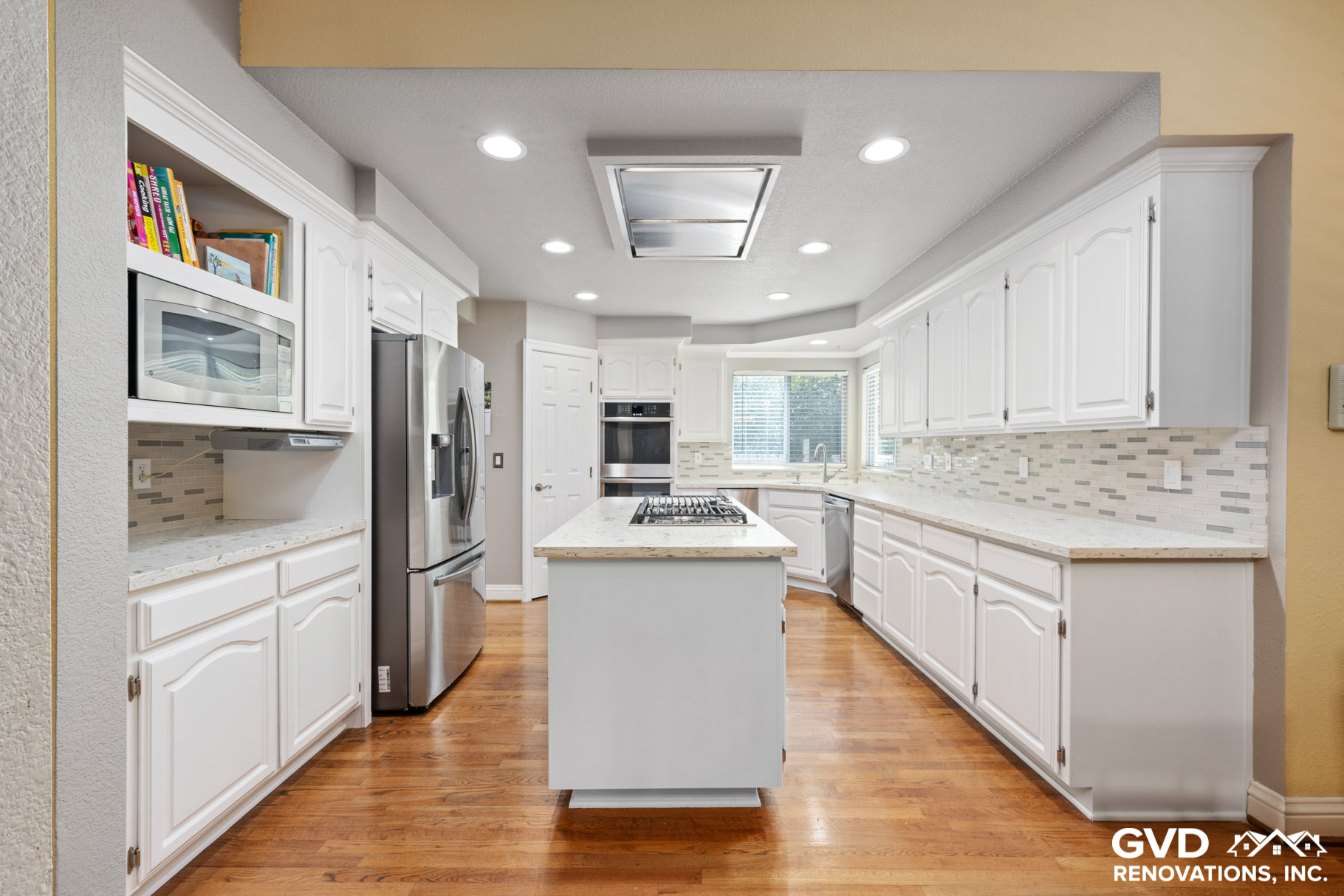
North Highlands General Contractor
North Highlands remodels with one accountable general contractor instead of five separate trades. Serving North Highlands, Elverta, and Arden Arcade, with a firm price in a detailed digital proposal.


A North Highlands remodel, at a glance
The typical numbers for a North Highlands remodel, from the most common scope to how long it takes.
Real North Highlands-Area Remodels: Before & After
A look at real remodels GVD has delivered around North Highlands.


Key Takeaways
- Whether a permit is required depends on what the work changes rather than which room it is in: cosmetic work usually does not, structural or mechanical work usually does.
- You can confirm any contractor's license status, classification, bond, and disciplinary history on the CSLB website in about two minutes.
- Unpermitted work has to be disclosed or gets discovered at resale, which routinely stalls escrow or forces a price reduction.
- Materials and finishes can be reviewed in person at GVD's design showroom on Five Star Blvd in Rocklin before selections are locked in.
- California caps down payments on most home improvement contracts at 10% of the contract price or $1,000, whichever is less.
- California requires a license for any home improvement job where labor and materials total $1,000 or more (the threshold since January 1, 2025), under Business and Professions Code 7048.
One contractor, every trade
On a North Highlands remodel, GVD acts as the one party accountable for design, trade scheduling, any required permits through Sacramento County, and inspections, from the first measurement to the final walkthrough. We also take on remodels in nearby Elverta, Arden Arcade, and Citrus Heights.
A time-and-materials bid gives you an hourly rate and an estimate, then charges you for whatever the hours and receipts add up to when the work is done, which means the final number is unknown until the job ends. A fixed-price proposal names the full scope and one firm total before the crew starts, so the number you approve is the number you pay. GVD builds its North Highlands remodels on the second model, with no surprise charges once the crew is on site.
A remodel with six separate trades and no single owner of the schedule is where delays start. GVD puts one project manager on the job whose only responsibility is that nobody is waiting on anybody.
General contractor or specialty contractor?
Homeowners often assume any licensed contractor can take on any job. The license classification says otherwise, and it is worth knowing which one you are hiring.
Specialty contractors (roofers, electricians, window installers) are licensed for one trade. A Class B general building contractor is licensed to manage projects that combine several trades, which is what a kitchen remodel, a primary-suite remodel, or an addition involves.
Does California require your contractor to be licensed?
Knowing the threshold is useful in both directions: it tells you when a license is required and when a handyman is a legitimate choice.
The unlicensed "minor work" exemption in California tops out below $1,000 in combined labor and materials (Business and Professions Code Section 7048, updated January 1, 2025). It never covers permitted work, and it disappears if the person hires a helper or advertises as a contractor, so any real remodel requires a licensed contractor.
Hiring unlicensed above that threshold carries real exposure. An unlicensed contractor cannot pull permits under their own name, the homeowner has little recourse through the Contractors State License Board if the work fails, and many homeowner's insurance policies exclude damage caused by unlicensed work.
How to verify a contractor's CSLB license before you sign
Reviews tell you about outcomes; the license record tells you about standing. Both are worth checking and they answer different questions.
The CSLB keeps a public record for every licensed contractor: status, classification, bond, workers' compensation, and discipline. It takes a couple of minutes to check.
Look up the license number
Search the number on the bid at cslb.ca.gov. Anything other than an "Active" status, or a classification that does not match the work, is worth a direct question before you go further.
Confirm the bond and workers' compensation are current
Check the bond and workers' compensation lines on the same page. Missing workers' comp can shift injury liability onto the homeowner. You can look up GVD's license, #989637, the same way.
Red flags when hiring a contractor
Most complaints filed with the CSLB trace back to a small set of warning signs that appear before the first day of work, not after. Watch for these before you sign:
- Pressure to sign the same day, especially paired with a "today only" discount.
- No local business address, or a phone number that never calls back.
- A big deposit up front. For most home improvement contracts, California caps the down payment at 10% or $1,000, whichever is less.
- A verbal number or a one-line quote with no detailed scope.
- A bid without a license number, or one registered to a different business name.
- Hesitation when you ask to see nearby completed work.
If the scope, price, and schedule are not in writing before you sign, expect the same vagueness during construction.
Questions to ask before you hire
These take five minutes and make three competing bids genuinely comparable rather than superficially so:
- What is your CSLB license number, and can I look it up while you are here?
- Who performs the work, and who coordinates the trades?
- What is included in the fixed price, and what would trigger a change order?
- Who pulls the permit, and whose name is on it?
- How are payments scheduled, and what is due at signing?
- Can I see photos of a recent project nearby?
At GVD, one project manager coordinates every trade and one accountable team carries the job from quote to walkthrough. Good contractors answer all six questions without hesitating.
Do you need a permit for a North Highlands remodel?
Cosmetic work generally does not require a permit; anything that relocates plumbing, adds a circuit, alters framing, or adds square footage generally does. Sacramento County draws that line.
Unpermitted work goes uninspected and tends to surface at resale, where it can delay escrow or cut the price. GVD handles any required permits with Sacramento County as part of the same scope.
How the permit process runs
Nothing in the sequence is discretionary, which is why it can be planned around rather than worked around.
Expect plan submittal and review first, then the permit, then inspections at key points (usually framing, rough-in, and final) before the permit is closed.
HOA and architectural review
Not every property has an HOA, and not every HOA reviews every project. Finding out which applies to yours is a phone call worth making early.
Not every property sits under an HOA, and the ones that do vary in what they review. Your title paperwork has the answer.
HOA architectural review and the building permit are two different approvals on two different calendars. Exterior work is what typically triggers the HOA side; filing both at the start avoids waiting on one after the other.
What a remodel costs in North Highlands
A firm total for a clearly defined scope is the only figure that can be compared honestly between two companies, because an open-ended estimate can move in any direction after signing. Ask each contractor to price the same defined scope as one fixed total, and the comparison becomes real.
Remodel costs scale with scope, material selection, and whether plumbing or electrical is relocated, so a range only means something next to the project type it describes.
For the full pricing breakdown by scope, see our main home remodeling page. Single-service pricing is covered on its own page: bathroom remodeling in North Highlands and siding in North Highlands each carry their own current ranges rather than restating them here.
You get a detailed fixed-price proposal before anything starts, rather than a time-and-materials estimate that is only settled at the end.
How long a remodel takes
Homeowners planning around a date should work backward from the approvals rather than from the construction, since that is where the variability sits.
The spread in timelines comes mostly from design, plan review, and HOA schedules rather than construction itself, which is why early submittals matter.
Why North Highlands homeowners choose GVD Renovations
Before your North Highlands selections are locked, you can review materials and finishes in person at our Rocklin showroom on Five Star Blvd, comparing cabinet doors, countertop samples, and fixtures under real light rather than approving them from a thumbnail. That visit removes the guesswork that leads to change requests mid-project. On site, one accountable GVD team carry the work through as one coordinated team, so the schedule holds between trades instead of stalling while a rotating out-of-area crew waits for the next hand-off. Because North Highlands falls under Sacramento County, and when a permit is required, GVD handles the permitting process with the office that actually issues it. A national franchise routes those same steps through a distant branch that has never stood in your kitchen.
License #989637, full liability and workers' compensation coverage, an A+ BBB rating, and one project manager per job are the basics we spell out in every proposal.
Having worked through Sacramento County plan review before, we know what inspectors look for at framing, rough-in, and final.
Our showroom is at 6848 Five Star Blvd #6 in Rocklin, about 12 miles from North Highlands (roughly a 20-minute drive).
Recent remodeling projects near North Highlands
Recent home remodeling projects we have completed in nearby communities:
- Complete Home Remodel in Antelope (95843)
- Elegant Kitchen Remodel in Antelope (95843)
- 3 Bathroom Remodels in Antelope (95843)
- Complete Bathroom Remodel in Carmichael (95608)
Remodels We've Completed Near North Highlands
Serviced ZIP Codes: 95660, 95821, 95608

4.6/5

4.9/5

A+

5/5

5/5

5/5

5/5

4.8/5

5/5
We are fully insured with worker's compensation and general liability insurance to safeguard you and your home during our work.


GAF Certified Roofing Contractor


2025 James Hardie Service Excellence Award


LP Certified Installer Certificate


Angie's List Super Service Award

VSI Certified Installer

Best of Houzz 2020 Service Award


Financing made simple
- Fast application process
- Flexible payment options
- Check eligibility in minutes
Financing is offered through third-party lenders. Approval, rates, and terms depend on credit profile. Not all applicants qualify.

Checking eligibility will not impact your credit score
General Contractor Near North Highlands
We bring the same crews, materials, and workmanship to every community around North Highlands.
Frequently Asked Questions
about General Contractor in North Highlands
Why hire a general contractor in North Highlands?
One licensed contractor runs design, scheduling, permits, and every trade, so you are not coordinating separate plumbers, electricians, and carpenters yourself.
What should I budget for a remodel in North Highlands?
With GVD, a single-room remodel typically runs $25,000 to $75,000, a multi-room remodel $80,000 to $200,000, and a whole-home renovation $200,000 to $500,000 or more, depending on scope and finishes.
Does a contractor need a license for my project?
California's license threshold is $1,000 in combined labor and materials (since January 1, 2025), and any job that needs a building permit requires a licensed contractor regardless of cost.
How do I check a contractor's license?
Search the license number at cslb.ca.gov. GVD holds California license #989637; the record shows status, classification, bond, and workers' comp.
Do I need a permit to remodel in North Highlands?
Paint, flooring, and cabinet swaps generally skip permitting; structural, plumbing, electrical, and addition work generally needs one. GVD files any required permits with Sacramento County.
What is a normal down payment for a remodel in California?
State law caps the down payment on most home improvement contracts at 10% of the price or $1,000, whichever is less.