McClellan General Contractor
McClellan remodels with one accountable general contractor instead of five separate trades. Serving McClellan, Antelope, and Carmichael, with a firm price in a detailed digital proposal.


A McClellan remodel, at a glance
One licensed contractor, one project manager, and a detailed fixed-price proposal. Here is the shape of a typical McClellan remodel.
Recent Home Transformations Around McClellan
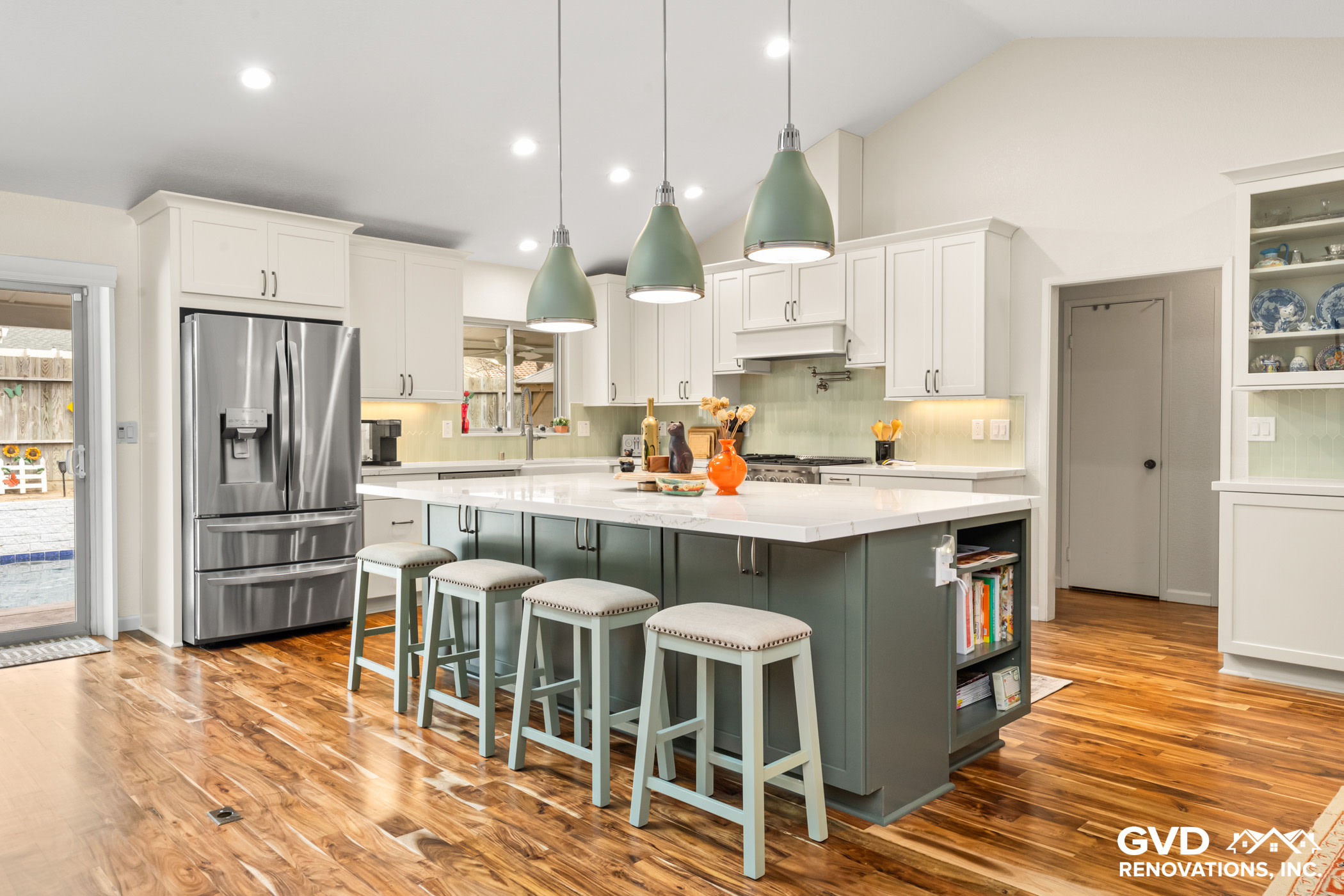
A look at real remodels GVD has delivered around McClellan.


Key Takeaways
- California requires a license for any home improvement job where labor and materials total $1,000 or more (the threshold since January 1, 2025), under Business and Professions Code 7048.
- Whether a permit is required depends on what the work changes rather than which room it is in: cosmetic work usually does not, structural or mechanical work usually does.
- Where an HOA has jurisdiction, its architectural review is a separate approval from the building permit and runs on its own committee schedule.
- A fixed-price proposal is a different instrument from a time-and-materials bid, where the final cost is not settled until the job finishes.
- A general contractor holds California's Class B license, which is what allows them to coordinate multiple trades on one project.
- GVD's in-house team self-performs most of the work, with one point of contact from the first site visit through final walkthrough.
What a general contractor does on your remodel
A general contractor is the single party responsible for a McClellan remodel from the first design sketch through the final walkthrough: coordinating the trades, handling permits with Sacramento County where they are required, and scheduling inspections, so you deal with one point of contact instead of five. We also take on remodels in nearby Antelope, Carmichael, and Elverta.
On most remodels you end up chasing five people, one for the estimate, one for scheduling, one for each trade, and no one who owns the whole timeline. GVD replaces that with a single project manager who handles the scope, the schedule, and the crews from the first site review through the final walkthrough. You call one number, and the person who answers already knows where your job stands.
What a general contractor actually sells is coordination. The trades are available to anyone; the sequencing is the part that is hard to buy separately.
General contractor or specialty contractor?
Comparing a specialty bid against a general contracting bid without noticing the difference is how homeowners end up managing their own project by accident.
Specialty contractors (roofers, electricians, window installers) are licensed for one trade. A Class B general building contractor is licensed to manage projects that combine several trades, which is what a kitchen remodel, a primary-suite remodel, or an addition involves.
Does California require your contractor to be licensed?
California is stricter than many states on this point, and the threshold catches almost all residential remodeling.
Since January 1, 2025, California's minor-work exemption covers only jobs under $1,000 in labor and materials, and only when no building permit is needed and the worker neither hires help nor advertises as a contractor (Business and Professions Code Section 7048). A remodel clears that bar immediately.
The risk lands on the homeowner: no permits in the contractor's name, little recourse through the CSLB if something fails, and possible insurance exclusions for damage tied to unlicensed work.
How to verify a contractor's CSLB license before you sign
A license number on a bid is a claim. The lookup is the verification, and the two are not the same thing.
The CSLB keeps a public record for every licensed contractor: status, classification, bond, workers' compensation, and discipline. It takes a couple of minutes to check.
Look up the license number
Use the License Lookup on cslb.ca.gov with the number printed on the bid, or search the business name. You want to see an "Active" status and the right classification, Class B for a general contractor.
Confirm the bond and workers' compensation are current
The same record lists the contractor's bond and whether workers' compensation coverage is on file. A lapsed bond or missing workers' comp can leave the homeowner exposed if someone is injured on the property. GVD Renovations holds California contractor license #989637, which you can look up directly.
Red flags when hiring a contractor
Most complaints filed with the CSLB trace back to a small set of warning signs that appear before the first day of work, not after. Watch for these before you sign:
- No CSLB number on the paperwork, or a number that belongs to someone else.
- No written description of the work, only a total.
- A business you cannot find at a real address.
- A big deposit up front. For most home improvement contracts, California caps the down payment at 10% or $1,000, whichever is less.
- No recent local references on request.
- Pressure to sign the same day, especially paired with a "today only" discount.
Get the scope, the price, and the timeline in a detailed digital proposal first. A contractor who resists that is showing you how the project will run.
Questions to ask before you hire
Six questions, all answerable on the spot. Ask them of every bidder so the comparison is like for like:
- Can I check your CSLB license number right now?
- Which parts of the job does your own team perform, and who coordinates the rest?
- What is included in the fixed price, and what would trigger a change order?
- Who is responsible for permitting, and who is listed as the permit holder?
- How are payments scheduled, and what is due at signing?
- Do you have a recent project near here I could see?
At GVD, one project manager coordinates every trade and one accountable team carries the job from quote to walkthrough. Good contractors answer all six questions without hesitating.
Do you need a permit for a McClellan remodel?
Whether a remodel needs a permit turns on what the work affects: structure, electrical load, or plumbing layout. Sacramento County applies that test to your specific scope.
Paint, flooring, cabinet swaps, and like-for-like fixtures usually do not need a permit. Moving plumbing, adding electrical circuits, removing walls, or adding square footage usually does.
Unpermitted work goes uninspected and tends to surface at resale, where it can delay escrow or cut the price. GVD handles any required permits with Sacramento County as part of the same scope.
How the permit process runs
The stages are the same for a small remodel and a large one. The paperwork depth and the queue are what differ.
Expect plan submittal and review first, then the permit, then inspections at key points (usually framing, rough-in, and final) before the permit is closed.
HOA and architectural review
HOA architectural review is the timeline variable homeowners most often forget, because it is invisible until you need it.
Where a governing document applies, the architectural submission is worth treating as the first task of the project rather than a late formality.
Where an HOA has jurisdiction, its architectural review is a separate approval from the building permit, with its own form and committee schedule. Interior work such as a kitchen remodel typically does not trigger it; exterior additions, siding changes, and patio structures usually do. Starting both early lets them run in parallel.
What a remodel costs in McClellan
A firm total tied to a defined scope is the only figure that means anything when you compare one company against another, because two quotes for different scopes are not actually comparable. Ask each company for the full scope and one fixed price in a detailed digital proposal, then set them side by side.
Two homeowners describing the same project in conversation can mean scopes that differ by a factor of five, which is why the bands are worth reading carefully.
For the full pricing breakdown by scope, see our main home remodeling page. Single-service pricing is covered on its own page: bathroom remodeling in McClellan and siding in McClellan each carry their own current ranges rather than restating them here.
GVD provides a free detailed fixed-price proposal before work starts, so the number you approve is the number you pay, with no surprise charges once the crew is on site. That differs from a time-and-materials bid, where the final cost is not settled until the job is finished.
How long a remodel takes
Homeowners planning around a date should work backward from the approvals rather than from the construction, since that is where the variability sits.
The spread in timelines comes mostly from design, plan review, and HOA schedules rather than construction itself, which is why early submittals matter.
Why McClellan homeowners choose GVD Renovations
We put the full scope and one fixed price in a detailed digital proposal before any wall comes down, and that detailed digital proposal is what protects you when a remodel exposes work that was not visible at the estimate. The number you approve is the number you pay, so a surprise behind the drywall does not become a surprise on your invoice. Our in-house crews, who self-perform most of the work, run the job as one coordinated team, which keeps the schedule from stalling between trades the way it does when rotating out-of-area crews cycle through a project. Permitting in McClellan runs through Sacramento County, and when a permit is required, GVD handles the permitting process so the inspection sequence lines up with the build instead of holding it up.
License #989637, full liability and workers' compensation coverage, an A+ BBB rating, and one project manager per job are the basics we spell out in every proposal.
Our permit submittals are prepared for what Sacramento County plan reviewers look for, which helps inspections stay on schedule.
Our showroom at 6848 Five Star Blvd #6 in Rocklin, about 13 miles from McClellan (roughly a 20-minute drive) is where cabinetry, stone, tile, and fixtures get chosen side by side.
Recent remodeling projects near McClellan
Recent home remodeling projects we have completed in nearby communities:
- Complete Home Remodel in Antelope (95843)
- Elegant Kitchen Remodel in Antelope (95843)
- 3 Bathroom Remodels in Antelope (95843)
- Complete Bathroom Remodel in Carmichael (95608)
Recently Completed Remodeling Projects Near McClellan
Serviced ZIP Codes: 95652, 95660

4.6/5

4.9/5

A+

5/5

5/5

5/5

5/5

4.8/5

5/5
We are fully insured with worker's compensation and general liability insurance to safeguard you and your home during our work.


GAF Certified Roofing Contractor


2025 James Hardie Service Excellence Award


LP Certified Installer Certificate


Angie's List Super Service Award

VSI Certified Installer

Best of Houzz 2020 Service Award


Financing made simple
- Fast application process
- Flexible payment options
- Check eligibility in minutes
Financing is offered through third-party lenders. Approval, rates, and terms depend on credit profile. Not all applicants qualify.

Checking eligibility will not impact your credit score
General Contractor Near McClellan
We bring the same crews, materials, and workmanship to every community around McClellan.
Frequently Asked Questions
about General Contractor in McClellan
What does a general contractor do on a McClellan remodel?
A general contractor coordinates every trade on the project, handles any required permits with Sacramento County, schedules inspections, and is the single point of contact from design through the final walkthrough.
What should I budget for a remodel in McClellan?
With GVD, a single-room remodel typically runs $25,000 to $75,000, a multi-room remodel $80,000 to $200,000, and a whole-home renovation $200,000 to $500,000 or more, depending on scope and finishes.
When does California require a licensed contractor?
Yes for any real remodel. California requires a license when labor and materials total $1,000 or more, and the minor-work exemption never covers permitted work.
How do I check a contractor's license?
Search the license number at cslb.ca.gov. GVD holds California license #989637; the record shows status, classification, bond, and workers' comp.
Do I need a permit to remodel in McClellan?
Paint, flooring, and cabinet swaps generally skip permitting; structural, plumbing, electrical, and addition work generally needs one. GVD files any required permits with Sacramento County.
How much can a contractor ask for as a deposit?
For most home improvement contracts, California limits the down payment to 10% of the contract price or $1,000, whichever is less.