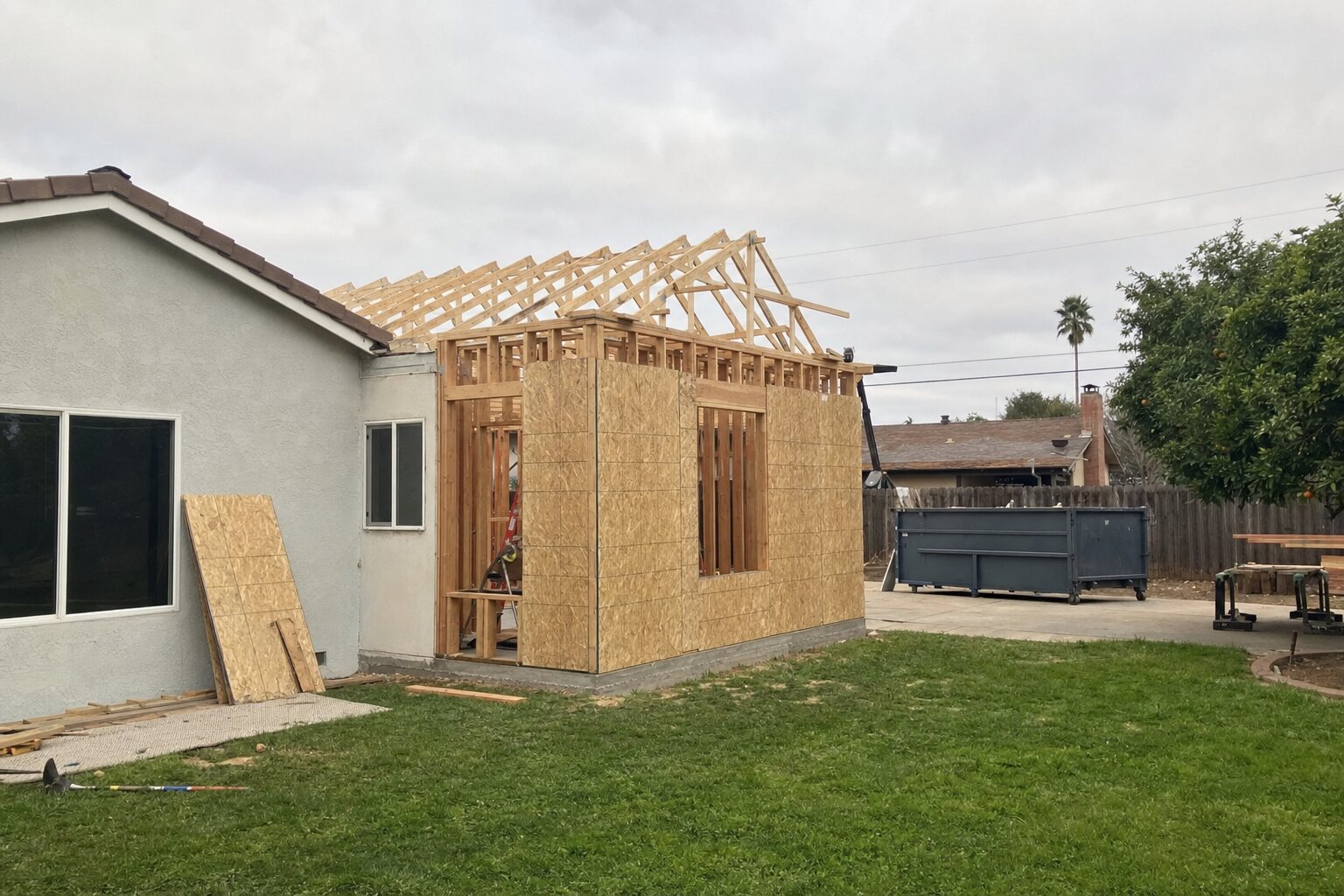
Cameron Park Home Additions
Home addition design and construction in Cameron Park, CA — one project manager from permit through final walkthrough, one accountable local crew.
A Cameron Park home addition, at a glance
GVD designs, permits, and builds your addition under one roof. Here is the shape of a typical Cameron Park project.
Key Takeaways
- An ADU costs less than a comparable attached addition in most regional bids and can generate rental income, while an attached addition adds square footage tied directly to the main house.
- Design and permitting account for roughly 6 to 10 weeks before construction starts, which is the part of the timeline homeowners most often underestimate.
- A bump-out that keeps the existing roofline and foundation type is the least expensive way to gain a few feet in a kitchen or bathroom.
- Additions in the Sacramento region typically run $250 to $450 per square foot, which puts a 400 sq ft master suite in the $100,000 to $180,000 range.
- GVD Renovations holds California contractor license #989637, carries a 4.9/5 rating across 921+ reviews, and assigns one project manager to every addition from design through walkthrough.
Home additions in Cameron Park, CA: what GVD Renovations builds
Home addition services in Cameron Park, CA cover everything from a single bedroom bump-out to a full second story, and GVD Renovations designs, permits, and builds them under one contract.
The first real question on any addition is whether you build up or build out, and the lot usually settles it before the budget does. A parcel with room to spare invites a ground-level extension, while a tight footprint pushes the new square footage onto a second story. GVD reads the lot first, because the answer changes the foundation, the framing, and the scope you are actually pricing.
GVD builds room additions, master suite additions, second-story additions, garage conversions, and attached ADUs in Cameron Park. Each project moves through the same design, permit, and construction sequence, with the scope adjusted to the addition type and the lot.
What separates GVD from a name pulled off a contractor directory is the accountability chain: one project manager tracks your job from the first design sketch through the final inspection, rather than a rotating cast of crews you meet for the first time on site. Because the same team designs, permits, and builds the addition, there is no handoff between a design firm and a construction crew where scope gets lost.
Get a fixed-price quote for your Cameron Park addition: call (916) 269-0761 or request a free consultation online.
How much a home addition costs in Cameron Park
A flat-lot slab addition and a raised foundation stepping down a slope are different projects even at identical square footage, since one pours on grade and the other carries the structure over uneven ground. Knowing which one your lot demands before you call keeps the budget conversation tied to the actual build.
Bump-out, 4 to 8 ft extension, $20,000 to $60,000. Extends an existing room without adding a new one. Usually needs only a small foundation extension and can often reuse the existing roof structure with a cantilever or a shed roof. Best for expanding a kitchen or bathroom.
Garage conversion, 400 to 500 sq ft, $40,000 to $75,000. Reuses existing walls, roof, and often the slab, which skips the excavation and framing cost of a ground-up addition. Brings parking-replacement and setback review into scope.
Standard bedroom addition, 12x12, $50,000 to $85,000. 144 sq ft of fully framed, foundation-supported space. Skips the plumbing rough-in that drives master suite costs. Best for a bedroom or home office.
Master suite addition, 400 sq ft, $100,000 to $180,000. Primary bedroom with attached bath and walk-in closet. Ground-floor additions in the Sacramento region run roughly $250 to $450 per square foot; a second storey runs closer to $300 to $500 because the existing first floor has to be engineered to carry the load.
Detached ADU, $150,000 to $300,000. A separate code-compliant living space with its own kitchen and bathroom. Often less per square foot than a comparable attached addition, because California's statewide ADU law puts these plans on a faster and more standardized review path.
How much of the existing house has to be opened up to tie in plumbing and electrical is the third driver after foundation and roofline, and it is the one most often underestimated at the design stage.
The least expensive way to add square footage is a bump-out that keeps the existing roofline and foundation type, or a garage conversion that reuses walls, a roof, and often a slab that already exist. Converting a garage into living space skips the excavation and framing costs of a ground-up addition, though it does bring the parking-replacement and setback review that El Dorado County applies to garage conversions.
For the full pricing breakdown by scope, see our main home additions page.
Room additions and bump-outs in Cameron Park
A room addition adds fully framed, foundation-supported square footage to the house, while a bump-out extends an existing room by a few feet without adding a full new room.
Full room additions: bedrooms, master suites, kitchens
Kitchens are the outlier among room additions. The square footage prices like any other room, but the mechanical, electrical, and cabinetry scope inside it puts a kitchen addition closer to a master suite than to a bedroom.
Bump-out additions: when the smaller footprint makes sense
The bump-out is underrated. Four to eight feet is often exactly what an awkward kitchen or a cramped bathroom needs, and because it can frequently cantilever off the existing structure it avoids the foundation cost that dominates a full addition.
Second-story addition vs ground-floor addition
Whether it is cheaper to build up or build out depends on your lot: a second-story addition avoids new foundation costs but requires structural reinforcement of the existing first floor, while a ground-floor addition needs a new foundation but leaves the existing structure untouched.
| Factor | Second-story addition | Ground-floor addition |
|---|---|---|
| Foundation work | None needed, but the first floor often needs reinforcement | New foundation required |
| Impact on lot coverage | None, stays within the existing footprint | Reduces yard space, subject to setback limits |
| Typical timeline | 4 to 7 months | 3 to 6 months |
| Best for | Small or narrow lots with tight setbacks | Lots with usable side or rear yard space |
A second story avoids the new foundation but pays for it twice over in structural reinforcement below and the exposure risk of an open roof. It earns its premium on constrained lots and rarely on open ones.
Home addition vs ADU: which adds the space you need
An attached home addition adds square footage that becomes part of the main house, while an accessory dwelling unit is a separate, code-compliant living space with its own kitchen and bathroom that can be rented out or used by a family member.
A detached ADU in the Sacramento region typically costs $150,000 to $300,000 depending on size and finish level. That is often less per square foot than a comparable attached addition once permitting under California's statewide ADU law is factored in, because ADU plans face a faster, more standardized review path in most jurisdictions.
An ADU makes more sense than an attached addition when the goal is rental income, a separate space for aging parents, or a use that benefits from full independence from the main house, such as a home office with client visits. An attached addition makes more sense when the new space needs to function as part of daily life in the main house, such as an expanded kitchen or a primary suite.
Addition permits through El Dorado County
Whether a permit applies turns on whether the footprint, the plumbing, or a load-bearing wall changes. On an addition that is usually all three. GVD files with El Dorado County and works through the plan check cycle on your behalf.
Building without a required permit risks a stop-work order and can force you to open up finished walls later so an inspector can verify what is behind them, which costs more than handling it up front. GVD manages this process with El Dorado County on every addition where a permit applies, so you are not working through plan check corrections alone.
Setbacks, zoning, and fire-resistant construction
Setbacks and lot coverage are the two constraints that most often reshape an addition design, and both are parcel-specific. We check them against your address before drawing anything, because a design that violates either is a resubmittal waiting to happen.
If your parcel sits inside a mapped fire hazard severity zone, the addition's exterior assemblies are governed by Chapter 7A rather than by preference. We establish that at the first visit, since it narrows siding, window, and eave options before anything is drawn.
How long a home addition takes in Cameron Park
A typical home addition takes 4 to 7 months from the start of design to final inspection, with a single room addition on the shorter end and a second story or full master suite on the longer end.
Design and permitting account for roughly 6 to 10 weeks of that timeline, and construction itself runs 3 to 5 months depending on scope. What extends a timeline most often is plan check corrections that require resubmittal, a lot with a sloped or unusual foundation condition, or material lead times on custom windows and siding ordered for the addition.
Will an addition raise your property taxes and resale value?
A home addition will increase your property tax assessment, because Proposition 13 rules trigger a reassessment of the new square footage, not the entire property, once the county assessor records the completed permit. The increase applies only to the assessed value the addition adds, not to the home's full existing assessment.
At resale, additions that add functional square footage such as a bedroom or bathroom tend to recoup a meaningful share of their cost. Exterior replacement recoups closer to full cost by comparison: fiber cement siding replacement recouped about 114% of cost, roughly $24,420 in added value, in the 2025 Cost vs. Value Report, against about 97% for vinyl.
How to hire a licensed addition contractor in Cameron Park
An addition is a months-long structural project, which raises the stakes on contractor selection well above a typical remodel. Start with the license and work down.
- Confirm the contractor's CSLB license number is active and check for any disciplinary history or bond claims.
- Ask for proof of general liability insurance and workers' compensation coverage before any work starts.
- Request a detailed fixed-price proposal covering the full scope, not a verbal estimate or a rough range.
- Check for manufacturer certifications relevant to the materials you want, such as James Hardie Elite Remodeler status or LP SmartSide Master status.
- Read recent reviews on Google, Yelp, and the BBB, and note whether the contractor responds to negative reviews.
- Confirm who is on site day to day and whether the person who sold you the job is the person managing it.
Withhold two numbers until you have quotes in hand: your ceiling, and what anyone else has quoted. Both reliably move an estimate toward themselves rather than toward the real scope.
How GVD manages your Cameron Park addition from design to walkthrough
GVD's addition process runs through five stages, and the same project manager stays assigned across all five so nothing gets lost in a handoff between departments.
Why Cameron Park homeowners choose GVD
Additions go through full plan check rather than an over-the-counter approval, and El Dorado County corrects specific details on submittals that a contractor who has taken plans through that department learns to draw correctly the first time. That familiarity shortens the review cycle and keeps the design intact. When a permit is required, GVD handles the permitting process. The build runs on our own in-house crews, so the same coordinated team carries the project from the site review through the final walkthrough and stays accountable for what gets framed. You can also see finishes in person at our showroom before anything is ordered, which turns cabinet, floor, and fixture decisions on a Cameron Park addition into choices you have actually touched rather than guessed at from a sample chip.
We have taken addition plans through full plan review across El Dorado County and neighboring jurisdictions, so the structural calculations and energy compliance details that draw corrections are handled before the first submittal rather than after it.
Our Rocklin showroom is about 24 miles away.
Start your Cameron Park home addition
Call (916) 269-0761 to book a free in-home consultation. We assess the lot, check the setbacks and lot coverage that apply to your parcel, and follow up with the full scope and one firm total price in a detailed digital proposal.
Serviced ZIP Codes: 95682, 95672

4.6/5

4.9/5

A+

5/5

5/5

5/5

5/5

4.8/5

5/5
We are fully insured with worker's compensation and general liability insurance to safeguard you and your home during our work.


GAF Certified Roofing Contractor


2025 James Hardie Service Excellence Award


LP Certified Installer Certificate


Angie's List Super Service Award

VSI Certified Installer

Best of Houzz 2020 Service Award


Financing made simple
- Fast application process
- Flexible payment options
- Check eligibility in minutes
Financing is offered through third-party lenders. Approval, rates, and terms depend on credit profile. Not all applicants qualify.

Checking eligibility will not impact your credit score
Watch What Some of Our Clients Have to Say
Trusted by Thousands of Homeowners Across Northern California


Home Additions Near Cameron Park
We bring the same crews, materials, and workmanship to every community around Cameron Park.
Frequently Asked Questions
about Home Additions in Cameron Park
How much does a home addition cost in Cameron Park?
In Cameron Park, a bump-out runs about $20,000 to $60,000, a standard 12x12 bedroom addition $50,000 to $85,000, and a 400 sq ft master suite $100,000 to $180,000. Ground-floor additions in the Sacramento region run roughly $250 to $450 per square foot; a second story runs closer to $300 to $500 because the first floor has to be engineered to carry the load.
A room addition or an ADU — which adds the space I need?
An attached home addition adds square footage that becomes part of the main house, while an accessory dwelling unit is a separate, code-compliant living space with its own kitchen and bathroom that can be rented out or used by a family member.
Do I need a permit for a home addition in Cameron Park?
Whether a permit applies turns on whether the footprint, the plumbing, or a load-bearing wall changes. On an addition that is usually all three.
How long does a home addition take?
From the first design meeting to the close-out inspection, an addition typically runs 4 to 7 months in Cameron Park, with the construction phase being the shorter half on a straightforward project.
Will a home addition raise my property taxes?
A home addition will increase your property tax assessment, because Proposition 13 rules trigger a reassessment of the new square footage, not the entire property, once the county assessor records the completed permit.
A second-story or a ground-floor addition — which makes sense?
Whether it is cheaper to build up or build out depends on your lot: a second-story addition avoids new foundation costs but requires structural reinforcement of the existing first floor, while a ground-floor addition needs a new foundation but leaves the existing structure untouched.