Newcastle Countertops
Fixed-price countertop installation in Newcastle, CA — quartz, granite, and natural stone, templated and installed by one accountable local team.
Upgrade Your Kitchen with the Best Custom Countertops in Newcastle
Upgrade your kitchen with the top-rated custom countertop replacement company near you. From granite to quartz and more, we offer a wide variety of options to fit any style and budget. Trust our expert team for quality craftsmanship and service.


Tap images to enlarge
See More Recent Projects →A Newcastle countertop project, at a glance
GVD templates, fabricates, and installs under one accountable team. Here is the shape of a typical Newcastle kitchen countertop project.
Real Newcastle-Area Countertop Projects: Before & After
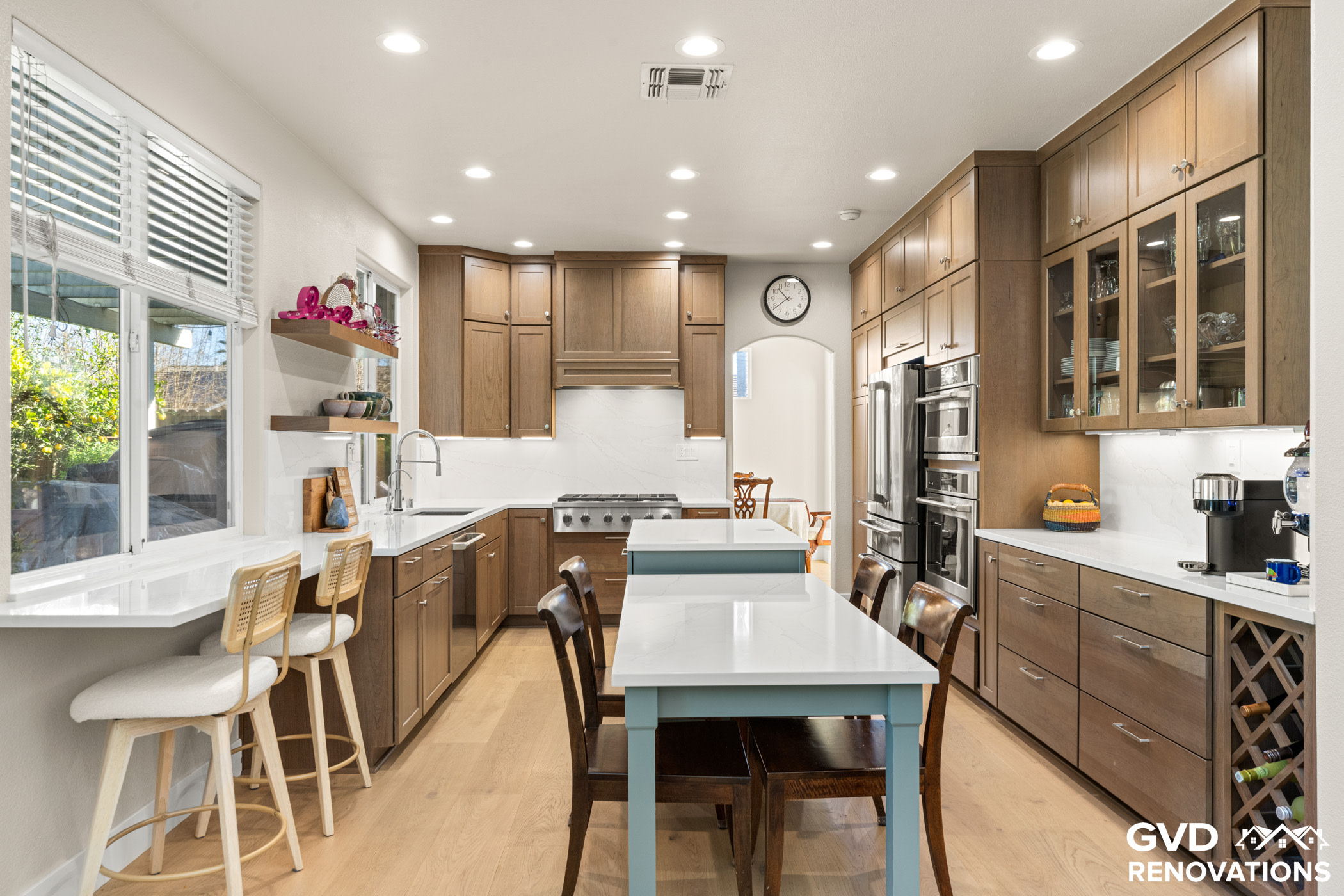
A look at GVD kitchen and countertop work from the Newcastle region.


Key Takeaways
- Never seal quartz. The resin binder is already nonporous, so sealer sits on the surface rather than absorbing.
- Edge profile and cutout count add fabrication time, and a farmhouse sink cutout costs more than a standard drop-in because it needs a finished front face.
- Quartz does not need a plywood substrate the way laminate does, but the cabinet box underneath still has to be level and rigid before install day.
- GVD quotes a fixed total price before work starts and assigns one project manager to track the job from template to walkthrough.
- A full countertop replacement, from template to finished install, typically runs 10 to 21 days once fabrication lead time is counted.
Countertop installation in Newcastle, CA
Countertop installation in Newcastle is handled by stone fabricators, big-box installation programs, and full-service remodeling contractors. Each route differs in who shows up on install day, and in who answers if a seam does not line up.
The slab is cut from the template, not from the numbers on your quote, which is why a precise field template is what actually determines whether your countertop fits. GVD templates the layout digitally against your installed cabinets before any slab is fabricated, so cutouts and overhangs match the room rather than a set of assumed dimensions. That step is the difference between a countertop that drops into place and one that gets adjusted on site.
One project manager tracks template, fabrication, and install from a single point of contact. On a job with a two-week gap in the middle waiting on the shop, that continuity is what keeps the install date from slipping twice.
How much countertop installation costs in Newcastle
A quote that names the slab line, the edge profile, and the number of cutouts can be compared against another quote line for line, because you are measuring the same variables on both. A quote that lists only "granite" or "quartz" cannot be compared to anything, since the material name alone hides the choices that move the total.
Smaller kitchen or a partial replacement, $10,000 to $15,000. A compact layout, fewer seams and cutouts, and a standard edge profile. Engineered quartz and standard granite sit in this band.
Typical single-kitchen replacement, $15,000 to $22,000. The range most single-kitchen projects land in. Material, square footage, edge profile, and the number of seams and cutouts decide where inside it you fall.
Larger layout or premium material, $22,000 to $30,000. Quartzite, marble, premium porcelain, or Dekton, larger islands, waterfall edges, and layouts with more seams and cutouts.
For the full pricing breakdown by scope, see our main countertop page.
A standard kitchen counter runs about 25 inches deep, so 20 linear feet works out to roughly 42 square feet once you account for the depth. That figure is what your fabricator prices against, which is why two kitchens with the same linear footage can quote differently once the layout, the seams, and the cutouts are counted.
Slab grade is the biggest single variable
Homeowners tend to think of material choice as quartz versus granite. In practice the grade within a material moves the number more than the choice between materials does.
What pushes your quote up or down
Edge profiles change price because more machining time goes into a full bullnose or ogee edge than a standard eased edge, and a waterfall edge on an island adds meaningfully to the total. Cutouts for a sink, cooktop, or outlet add fabrication time each, and a farmhouse sink cutout runs more than a standard drop-in because it requires a finished front face. Slab grade is typically the largest swing factor, with total square footage and seam count behind it.
Choosing a material for Newcastle kitchens
Sustained heat and strong direct light are what separate materials that hold up over a decade here from materials that fade or discolor.
For resale specifically, granite and quartz both read as upgrades, while laminate reads as a placeholder a buyer will plan to replace.
Quartz vs granite vs marble
| Material | Mohs hardness | Sealing needed | Heat tolerance |
|---|---|---|---|
| Quartz | ~7 | Never | Good, avoid direct hot pans |
| Granite | 6 to 7 | Every 1 to 2 years | Excellent, tolerates direct heat |
| Marble | 3 to 4 | Every 6 to 12 months | Fair, softer surface scratches |
Quartz is generally the better everyday countertop because it never needs sealing and resists the etching that damages marble. Granite still wins on raw heat tolerance, and the two sit close enough on price in most quotes that the choice usually comes down to maintenance tolerance rather than cost. Against marble, quartz wins on durability outright: marble's Mohs hardness of 3 to 4 makes it far softer than engineered quartz, which is the gap that shows up as scratches and etch marks after a few years of real use.
Quartz: hardness and UV behavior
Quartz has taken share from granite for one reason above all others: it never needs resealing. The tradeoff is that its resin binder rules it out for uncovered outdoor kitchens, where porcelain slab is the correct answer.
Granite: sealing and heat tolerance
Granite is natural stone, so every slab is different and the one you approve is the one that gets installed. That variation is the appeal for some homeowners and the reason others prefer engineered quartz.
Marble: why it struggles in a working kitchen
Marble is beautiful and it is soft. Those two facts are inseparable. On a primary work surface it etches from citrus and vinegar and scratches from ordinary use far more readily than harder stone.
Laminate and solid surface: the budget options
| Material | Repairable | Heat tolerance | Typical lifespan |
|---|---|---|---|
| Laminate | No, replace the sheet | Poor, scorches | 10 to 15 years |
| Solid surface (Corian) | Yes, sanded and buffed | Fair | 15 to 20 years |
Solid surface generally beats laminate for a busy kitchen because a scratch or burn can be sanded out rather than requiring a full sheet replacement. That tradeoff matters most once the counter has been in daily use for a few years. Laminate remains the cheaper of the two and the cheaper option against stone generally, which is why it still shows up in rental units and quick-flip remodels where resale value is not the priority.
How long a countertop installation takes
The install is a single day. Everything else in the 10 to 21 day window is fabrication queue and lead time, which is why the template date matters more than the install date when you are planning a kitchen.
Removing your old countertop before the new one goes in
Old counters do not lift off. They come up with a pry bar and a utility knife, and the cabinet boxes underneath are what take the damage when that goes wrong.
Old counters are typically fastened down with construction adhesive, silicone caulk at the backsplash, and sometimes screws through cabinet corner brackets, so they come up with a pry bar and a utility knife rather than lifting free. Tile counters are the hardest to remove cleanly, because the mortar bed underneath often has to come off in pieces. GVD includes removal and disposal of the old countertop in the project scope rather than pricing it separately.
Substrate, plywood, and the details that decide a lasting install
The slab is only as good as what it sits on. Stone and quartz do not need a plywood deck the way laminate does, but they do need cabinet boxes that are level, square, and rigid, and that is checked before the template rather than on install day.
Before install day, clear the cabinets of contents near the work zone, disconnect the sink plumbing if a plumber is not handling that step, and make sure the path from your driveway to the kitchen can accommodate a slab that may weigh several hundred pounds.
Sealing and caring for your new countertops
Most countertop damage comes from doing the right maintenance to the wrong material. Here is what each one actually needs.
- Seal granite and marble on install day, then reseal granite every 12 to 24 months and marble every 6 to 12 months depending on use.
- Never seal quartz. The resin binder in engineered quartz is already nonporous, so sealer sits on top rather than absorbing.
- Skip bleach-based cleaners on quartz, since repeated exposure can dull the resin's finish over time. Mild dish soap and water is enough for daily cleaning.
- Do not set a hot pan directly on quartz. The resin binder can scorch or discolor under sustained direct heat, unlike granite.
- Avoid abrasive scouring pads on any engineered surface, and wipe up wine, coffee, and citrus spills on marble and granite before they sit long enough to etch or stain.
Why Newcastle homeowners choose GVD Renovations
A contractor who sets your cabinets can template the countertops against what is physically installed, instead of scheduling a template around a date someone else promised to hit. When the cabinets and the counters run through one accountable team, the template happens when the boxes are actually level and secured, and a delay on one stage moves the next stage with it rather than stranding a crew that showed up on a fixed franchise slot. Our own in-house crews fabricate and install, so a slab that arrives flawed is re-cut by the people who templated it. Newcastle sits under Placer County, and when a permit is required GVD handles the permitting process. You review the slabs in person, and the number you approve is the number you pay.
- California contractor license #989637, with full liability and workers' compensation insurance carried on every job.
- A dedicated project manager assigned to your countertop or full kitchen remodel, tracking template, fabrication, and install from one point of contact.
- A detailed fixed-price proposal before work starts. The number you approve is the number you pay, with no surprise charges once the crew is on site.
- Any required permitting handled directly with Placer County, depending on the scope of the work.
- Our Rocklin showroom is about 12 miles away. See quartz, granite, and solid surface samples in person before committing.
We work across Placer County and neighboring jurisdictions, and where a project's scope brings a permit into play we handle that process rather than leaving it to you.
Recently Completed Countertop Projects Near Newcastle
Get a fixed-price countertop quote in Newcastle
Book the free in-home visit at (916) 269-0761. You get an accurate measure, honest guidance on which material suits how you actually use the kitchen, and a detailed fixed-price proposal with no obligation.
Serviced ZIP Codes: 95658

4.6/5

4.9/5

A+

5/5

5/5

5/5

5/5

4.8/5

5/5
We are fully insured with worker's compensation and general liability insurance to safeguard you and your home during our work.


GAF Certified Roofing Contractor


2025 James Hardie Service Excellence Award


LP Certified Installer Certificate


Angie's List Super Service Award

VSI Certified Installer

Best of Houzz 2020 Service Award


Financing made simple
- Fast application process
- Flexible payment options
- Check eligibility in minutes
Financing is offered through third-party lenders. Approval, rates, and terms depend on credit profile. Not all applicants qualify.

Checking eligibility will not impact your credit score
Watch What Some of Our Clients Have to Say
Trusted by Thousands of Homeowners Across Northern California


Countertops Near Newcastle
We bring the same crews, materials, and workmanship to every community around Newcastle.
Frequently Asked Questions
about Countertop Replacement in Newcastle
How much do countertops cost in Newcastle?
Most single-kitchen countertop replacements in Newcastle run about $15,000 to $22,000, with smaller or partial jobs from $10,000 and larger layouts or premium materials (quartzite, marble, Dekton) reaching $22,000 to $30,000. Material, square footage, edge profile, seams, and cutout count set the final number.
Which countertop is best — quartz, granite, or marble?
Quartz is generally the better everyday countertop because it never needs sealing and resists the etching that damages marble. Granite still wins on raw heat tolerance, and the two sit close enough on price in most quotes that the choice usually comes down to maintenance tolerance rather than cost.
Do quartz countertops need sealing?
No. Quartz's resin binder is already nonporous, so a sealer just sits on the surface. Granite should be sealed every 1 to 2 years and marble every 6 to 12 months.
How long does a countertop installation take?
The install is a single day. Everything else in the 10 to 21 day window is fabrication queue and lead time, which is why the template date matters more than the install date when you are planning a kitchen.
Do you remove and dispose of the old countertop?
Yes. Removal and disposal of your existing counter is part of our project scope, not something you have to handle yourself.
Can quartz countertops be used outdoors in Newcastle?
Quartz belongs on interior counters — sustained direct sun can yellow the resin binder in some colors. For outdoor kitchens we use porcelain slab, which is UV-stable.