

Black granite countertops are dense, hard, heat-tolerant natural stone counters that range from near-solid black (Absolute Black) to black flecked with gold or silver (Black Galaxy, Black Pearl) to black with bold white veining (Via Lactea, Black Forest). They are one of the most durable choices you can put in a kitchen, but they are not maintenance-free in the way people expect: the real issues with black granite are fingerprints, water spots, visible dust and scratches on a polished surface, and oil darkening on honed or leathered finishes, not acid stains. As of 2026, granite countertops typically run about $40 to $150 per square foot nationally, and the common black varieties sit in the lower to middle part of that range.
Key Takeaways
- Most "black granite" is not geologically granite. Stones like Absolute Black are usually gabbro or diabase. The stone trade sells them as granite because they perform like granite (and often better).
- Dense black granite countertops may not need sealer at all. Use a water test on your actual slab. Sealer that the stone can't absorb dries on the surface as a haze.
- Acid etching is a marble problem. Lemon juice and vinegar do not etch true black granite. If a "black granite" sample etches, it is probably marble or limestone.
- The finish decides how much you see. Polished black shows fingerprints, dust and fine scratches; honed shows grease and can look gray; leathered hides smudges and water spots best.
- Watch for dyed Absolute Black. An acetone wipe on an offcut is the standard check.
- Cost (as of 2026): granite runs about $40 to $150 per square foot (Fixr, updated January 2026). Honed and leathered finishes add to that.
- Outdoors: black granite handles Sacramento sun and weather, but it gets very hot in direct summer sun.
What "Black Granite" Usually Is
True granite is a light-colored igneous rock made largely of quartz and feldspar. Very few true granites are black. Most of the stones sold as black granite are darker igneous rocks such as gabbro, diabase, norite or basalt, which are rich in dark minerals like pyroxene and contain little or no quartz.
The stone industry groups these rocks together on purpose. The Natural Stone Institute explains that gabbro, diabase, basalt and many other igneous rocks are included in the commercial "granite" group because they behave and perform similarly to granite, and it uses an Absolute Black "granite" kitchen island as its example of a stone a geologist would call gabbro. That is good news if you are shopping for black granite countertops: these stones are as hard as granite and usually denser.
You may also see "engineered granite" in ads. It is not a standard countertop category. The term usually means engineered quartz or another resin-bound composite made to look like granite. If someone quotes it, ask exactly what the product is made of, who manufactures it, and what the warranty covers, then compare it with quartz on those terms.
Popular Black Granite Countertop Varieties
Names overlap between suppliers and quarries, so treat the origins below as typical rather than guaranteed, and always choose from the actual slab.
| Variety | Typical origin | Look | Good to know |
|---|---|---|---|
| Absolute Black | India; a Zimbabwe material is sold as Nero Assoluto Zimbabwe or Zimbabwe Black | Near-solid black, very consistent | "Nero Assoluto" is simply Italian for Absolute Black. The most uniform option, and the one most often dyed. |
| Black Galaxy | India (Andhra Pradesh) | Black with small gold or white flecks | The flecks catch light on a polished finish. |
| Black Pearl | India | Semi-solid black with silver, gold, gray and green speckles | Often one of the lower-priced black stones. |
| Titanium (Titanium Black) | Brazil | Black with swirling gray, gold, cream and ivory movement | High movement; plan seams with the fabricator. |
| Via Lactea | Brazil | Black with chalky white veining | Also sold as Milky Way. Offered polished or brushed. |
| Black Forest | Brazil | Black with heavy snow-white streaks | High variation from slab to slab. |
| Black Mist | Brazil (per Arizona Tile) | Black with faint gray areas and some white quartz veins | Usually sold honed; often compared to soapstone. |
Sources: supplier product pages from MSI (Absolute Black, Black Galaxy, Black Pearl, Titanium, Via Lactea, Black Forest) and the Arizona Tile Black Mist Honed spec sheet.
Solid, Flecked, or Veined?
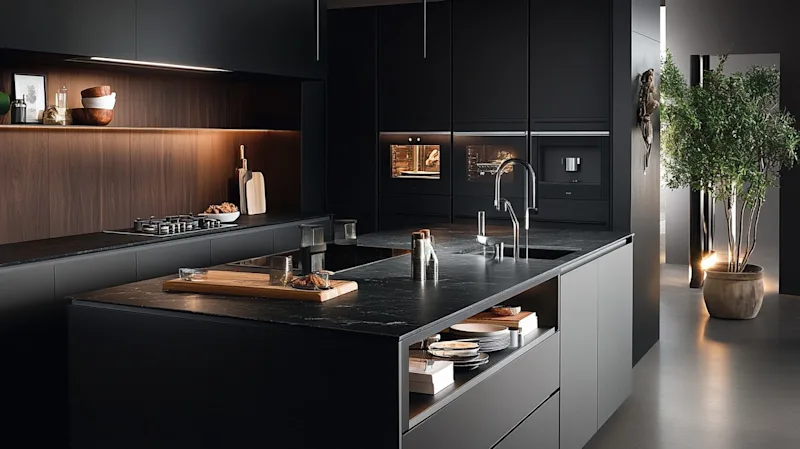
Solid black granite countertops (Absolute Black) read as one calm block of color and suit modern and minimalist kitchens. Flecked stones (Black Galaxy, Black Pearl) hide crumbs and dust a little better because the surface is already busy. Veined stones (Via Lactea, Black Forest, Titanium) act as the focal point of the room, so they work best with plain cabinets and a simple backsplash.
How to Spot Dyed or Fake Black Granite
Some imported black stone is gray or dark gray by nature and is darkened with dyes or oils before sale. On black granite countertops, the problem shows up later: the color fades or turns blotchy as cleaning slowly removes the dye. Stone restoration expert Fred Hueston, writing in Stone World, names Absolute Black, Black Galaxy and Zimbabwe Black among the stones affected and notes that there is no real fix other than dyeing the stone again.
The Acetone Test
Ask for an offcut or test an inconspicuous spot (never the middle of the counter). Wet a clean white cloth with acetone and rub firmly. If black color or residue comes off on the cloth, the stone has been dyed. If nothing transfers, Hueston suggests repeating the test with MEK (methyl ethyl ketone) on a different spot, since some dyes do not react to acetone. A clean result is a good sign, not a guarantee, so buy from a supplier that will state in writing that the slab is not dyed.
Do not confuse dye with a color enhancer. Honed black stones look charcoal gray until a fabricator applies an enhancing sealer, which is a normal, disclosed step. Arizona Tile notes that all honed black granites start out deep gray and that an enhancer brings out the black. An enhancer can wear and need reapplying; it is not a defect, but you should know if your slab has one.
The Lemon Juice Check
Black marble and black limestone are sometimes sold next to black granite. Put a few drops of lemon juice on a sample for a few minutes, then rinse. True black granite will not change. A dull or lighter spot means the stone contains calcite and will etch, which makes it a marble-type stone, not granite.
Polished, Honed, or Leathered Black Granite Countertops
The finish changes how black granite countertops look and how much daily wear you notice, more than it changes durability.
| Finish | Look | Fingerprints and water spots | Upkeep | Typical added cost |
|---|---|---|---|---|
| Polished | Deepest black, mirror-like | Shows fingerprints, streaks, dust and fine scratches in raking light | Lowest absorption; least sealing | None |
| Honed | Matte, can look charcoal gray without an enhancer | Fingerprints, grease and dust are more visible | More absorbent; may need sealing yearly or more | About $10 to $20 per sq ft |
| Leathered (brushed) | Soft sheen with a slight texture | Best at hiding smudges, water spots and crumbs | Wipe with the grain; can trap residue if soap is left behind | About $15 to $25 per sq ft |
Finish comparisons from MSI; added costs from Fixr's granite cost guide (updated January 2025). Arizona Tile adds that black granite is one of the hardest stones to hone well because it shows buffer marks and oils from fingers. If you are drawn to the leathered look, see our guide to leathered granite.
Do Black Granite Countertops Need Sealing?
Many black granite countertops don't. The Natural Stone Institute's consumer site notes that darker granites are very dense and sometimes don't even require a sealer. A polished Absolute Black slab may absorb almost nothing. That is why the old advice to "seal black granite every year" causes problems: when the stone can't take the sealer in, the excess dries on top as a cloudy film.
Honed and leathered black granite, and some of the more open-grained veined stones, are a different story. They can absorb oil and water, and Arizona Tile says its honed Black Mist may need resealing as often as every six months indoors.
Use the Water Test, Not the Calendar
Pour a little hot water on a high-use area (next to the sink or cooktop) and leave it for 10 to 20 minutes, then wipe it off. If the stone darkened, it is absorbing and should be sealed. If it looks the same, skip the sealer. This is the test Use Natural Stone recommends, and it tells you more than any fixed schedule. Repeat it once a year or whenever water stops beading.
What Causes Haze, and How to Fix It
- Sealer residue: the most common cause on dense black stone. Apply a small amount of the same sealer to re-wet the film, then buff dry with a clean cloth within a few minutes. If that fails, use a stripper made for stone sealers, tested on a hidden spot first.
- Soap film: dish soap and oil-based cleaners leave a greasy layer that shows clearly on black. Switch to a pH-neutral stone cleaner, rinse, and dry.
- Hard-water marks: dried tap water leaves white rings, especially around the faucet. Wipe the area dry daily.
- Worn enhancer: on honed black, uneven gray patches can mean the enhancer is wearing off. A fabricator or stone restorer can reapply it.
Caring for Black Granite Countertops Day to Day
Daily care for black granite countertops is simple. Use Natural Stone recommends wiping granite daily with a neutral cleaner and warns that regular dish soap leaves a film that can dull or streak stone. On black stone, that film is easy to see.
- Clean: a pH-neutral stone cleaner or plain warm water and a microfiber cloth. Dry with a second cloth to avoid streaks and spots.
- Avoid: vinegar, ammonia, bleach, abrasive powders and "cleaner plus polish" products that leave an oily or waxy residue. They will not etch true granite, but they can break down sealer or enhancer and leave smears.
- Wipe up oil promptly, especially on honed or leathered finishes. Cooking oil can soak in and leave a darker patch. A stone poultice can usually draw it out.
- Use cutting boards. Granite rates about 7 on the Mohs scale, so knives rarely scratch it, but grit dragged under a pan or a ceramic dish with a rough foot can leave fine marks that show on polished black.
- Use trivets under pots and slow cookers. Granite itself will not melt or blister from a hot pan, but trivets protect sealers, enhancers and resin-filled spots, and they avoid sudden temperature swings near cutouts and seams.
What Actually Goes Wrong With Black Granite
Forget acid stains. With true black granite, the complaints are cosmetic: fingerprints and streaks on polished surfaces, white water rings near the sink, oil darkening on matte finishes, fading on dyed slabs, and haze from too much sealer. Chips can happen at sink edges and corners from a hard knock, and a fabricator can usually fill them with a color-matched resin.
Design Ideas for Black Granite Countertops
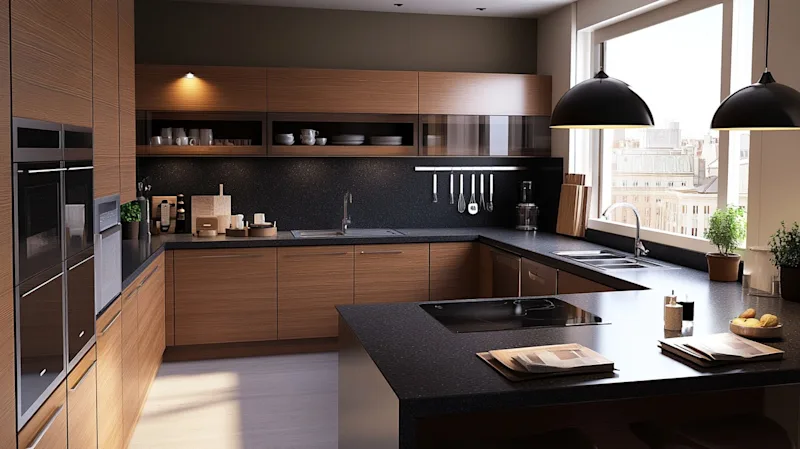
Cabinets. White and warm-white cabinets give the cleanest contrast and keep a kitchen bright. Natural wood, such as white oak or walnut, softens black granite and suits both modern and traditional homes. Mid-gray or greige cabinets give a quieter, tonal look; if you choose dark cabinets too, balance them with light floors, walls and good lighting so the room does not feel heavy.
Backsplash. With solid Absolute Black, almost anything works: white subway or zellige tile, a marble-look slab, or a full-height backsplash in the same stone. With busy stones like Black Galaxy, Via Lactea or Black Forest, keep the backsplash plain so the counter and wall do not compete.
Hardware and fixtures. Brushed brass and warm bronze pop against black. Stainless and polished nickel feel crisp and modern. Matte black hardware creates a monochrome look that pairs well with leathered stone.
Lighting. Dark counters absorb light, so plan strong under-cabinet task lighting. Expect that light to show smudges on polished black, which is one more reason many homeowners now choose leathered black granite.
Black granite countertops also make practical bathroom vanity tops. They resist moisture well, though toothpaste and water spots show on a polished finish.
How Much Black Granite Countertops Cost in 2026
As of 2026, Fixr puts granite countertops at about $40 to $150 per square foot (updated January 2026). Its granite guide (updated January 2025) uses a national average of about $3,500 for 30 square feet of average-grade granite with a simple eased edge and no backsplash. These are national typical ranges, not quotes, and local prices vary.
| Cost item | Typical range |
|---|---|
| Absolute Black or Black Galaxy (material) | About $40 to $80 per sq ft |
| Black Pearl (material) | About $40 to $50 per sq ft |
| Installation labor | About $30 per sq ft on average |
| Honed finish | Add about $10 to $20 per sq ft |
| Leathered finish | Add about $15 to $25 per sq ft |
| Decorative edges (bevel, bullnose, ogee) | Add about $10 to $25 per linear ft |
Material and add-on figures: Fixr granite countertop cost guide, updated January 2025.
Black granite countertops in common colors like Absolute Black and Black Pearl are usually among the more affordable natural stone options. Heavily veined Brazilian stones, thicker slabs, honed or leathered finishes, complex edges, extra seams, sink cutouts and tear-out of the old tops push the price up. Get the price for the specific slab, finish and edge in writing.
Black Granite vs. Black Quartz vs. Soapstone vs. Nero Marquina
If you want a black kitchen counter, these four materials come up most often. Here is how black granite countertops compare.
| Black granite | Black quartz | Soapstone | Nero Marquina | |
|---|---|---|---|---|
| What it is | Natural igneous stone (often gabbro or diabase) | Engineered: crushed quartz, resin and pigment | Natural talc-rich stone | Black marble/limestone from Spain with white veins |
| Scratches | Very hard | Hard | Soft; scratches but sands out | Soft; scratches |
| Lemon, vinegar, wine | No etching | No etching | Generally unaffected | Etches |
| Heat | High tolerance; trivets still wise | Resin can scorch; use trivets | High tolerance | Tolerant, but use trivets |
| Sealing | Only if the water test says so | None | None; mineral oil optional for color | Yes |
| Look | Solid, flecked or veined; each slab differs | Most uniform; many patterns | Soft charcoal, darkens with use | Dramatic white veining |
| Typical cost (Fixr, 2026) | $40 to $150/sq ft | $50 to $200+/sq ft | $50 to $120/sq ft | $50 to $200/sq ft (marble) |
Black quartz is the choice if you want a perfectly even black with zero sealing. It is less tolerant of direct heat, and standard indoor quartz is not rated for outdoor sun. See our roundup of black quartz countertop ideas.
Soapstone gives a soft, matte, almost velvety charcoal that shrugs off heat and acids but scratches easily and develops a patina. Read more in our soapstone countertops guide.
Nero Marquina has the most dramatic veining of the four, but it is a calcite stone, so citrus, wine and vinegar will etch it. If etching would bother you, choose a veined black granite like Via Lactea instead. Our marble countertops guide explains etching in detail.
Black Granite in Sacramento Outdoor Kitchens
Granite is one of the better outdoor countertop materials. It is not damaged by UV light the way resin-based products can be, and it handles winter rain well when properly installed and supported. Black granite countertops have one catch in the Sacramento Valley: summer afternoons often pass 100°F, and MSI notes that dark granites get hot in direct sun. A black counter in full afternoon sun can become uncomfortable to touch or set things on.
- Shade it. A pergola, patio cover or the house's own shadow for the afternoon hours makes a big difference.
- Consider the finish. Polished black reflects glare. Leathered or honed black is easier on the eyes outdoors, though it may need sealing more often.
- Go lighter in full sun. For an uncovered bar top facing west, a gray or lighter granite stays cooler.
- Don't hose it down cold. MSI warns against cooling hot granite with cold water; use lukewarm water if you need to.
- Check sealing yearly. Outdoor stone faces more weather, so run the water test each spring.
Common Questions About Black Granite
Are black granite countertops hard to keep clean?
They are easy to clean but quick to show it when they are not. A daily wipe with a neutral cleaner and a dry microfiber cloth handles most of it. If smudges bother you, choose a leathered finish or a flecked stone like Black Galaxy over polished Absolute Black.
Is black granite non-porous?
Not completely, but dense black stones like Absolute Black absorb very little, which is why many need little or no sealer. Honed and leathered finishes absorb more. The water test tells you where your slab falls.
Can you put hot pans on black granite?
Granite will not melt or scorch from a hot pan, but use trivets anyway. They protect any sealer or enhancer, and they avoid thermal stress near sink cutouts and seams.
How GVD Can Help With Black Granite Countertops
GVD Renovations & Remodeling installs granite, quartz, quartzite, marble and porcelain countertops across the Sacramento region, as a standalone countertop replacement or as part of a full kitchen remodel. You pick the actual slab in person at our Rocklin showroom rather than from a small sample, so you can see how a black granite looks in polished, honed or leathered form and compare it side by side with black quartz or soapstone. One project manager runs the job from template to final walkthrough. To talk through options for black granite countertops in your kitchen, visit our Sacramento countertops page and request a free estimate.
Reviewed by our team at GVD Renovations, a licensed general contractor. While we strive for accuracy, project specifics vary. Contact us for a personalized assessment. Product details, specifications, or warranties may have changed since publication. Brand and product mentions reflect our professional opinion, not endorsements or guarantees.
Tags: granite countertops, black countertops, kitchen renovation,


Written by Sam Rutkevich, Renovation Specialist ·


